www.anarchism.net
On the Steppes of Central Asia
by Matt Stone (ed. Richard D. Fuerle)
At the time this all happened I was a journalism major in my junior year at Harvard. I was an editor of the Crimson, the student newspaper, and had ambitions to be an investigative reporter, like Woodward and Bernstein. “Smell the dirt and dig” was my motto.
My years at Harvard had been a real eye-opener for me. I always had tried to keep up with current events, and thought I knew a lot about politics and economics. But at Harvard I learned the theoretical basis for many of my beliefs. For example, in economics, I learned about market failures that result in pollution, recessions, unemployment, and inflation, and the actions government could take to solve these problems. I learned how regulations prevented business people from producing poor quality or dangerous products, and how antitrust laws broke up monopolies and protected consumers.
In sociology, I learned about how racism resulted in poverty for blacks, how the absence of enough public housing aggravated homelessness, how more social programs would help relieve crime, teenage pregnancy, illiteracy, broken homes, child abuse, and poverty. In polisci, I learned how greedy special interests obtained government money and contracts, and advantages in the marketplace, for themselves at the expense of the general welfare, how corporations manipulated the politicians to avoid taxes and regulations, and how our government protected our freedom and fostered prosperity.
In history courses, I learned about the evils of the Industrial Revolution - child labor, pollution, crowded cities. How, until the FDA, charlatans sold dangerous medicines, and how the robber barons monopolized industry. In philosophy, I learned, from Rawls, that if we assume we do not know our future position in society, we will all agree now to distribute wealth equally. It all fit together. It was a weltanschauung of a nation, or even a world community, of people working together through government for the common good, repressing the divisiveness of greed and racism - one big happy family.
I am telling you this so you can see where I’m coming from, and you will be able to see why what was about to happen to me was so shocking and upsetting.
One day in the early spring of 1990, I received a strange letter at the student newspaper office from a place named Ulaanbaatar, which I had never heard of, in the Republic of Mongolia, of which I knew next to nothing. Indeed, I doubt that I could have even pointed to it on a globe. It was from a man named “Kley Urtnasan,” who identified himself as the Minister of Cultural Exchanges of the Republic of Mongolia. In the letter he invited me to come to Ulaanbaatar for three months to work at the Mongolian Free Press, helping to publish their English-language edition. It included a small salary, and I was promised an experience that would “change the way you look at the world. Your life will never be the same again.” That seemed like overselling to me, for what would probably be at most an interesting, but irrelevant, diversion in my career. I would have to pay air fare, but I would live in his house and be given access to government officials as well as many community leaders. Interesting, I thought, but not for me.
That weekend I visited my mother and told her about the offer to go to Mongolia. Immediately she was totally against it. “It’s too dangerous,” she said. She charged through her collection of old magazines until she found, in World Press Review, a short article about the massacre of Communist leaders that had occurred there. Some had been dismembered and sold for body parts, at least according to the article. “These people are barbarians,” she said in a distressed voice. I assured her I wasn’t going to go since I didn’t have the air fare and already had several good job prospects for the summer anyway.
I thought no more about it until, a few days later, I received a call from my cousin Eric, who has some job at the State Department. After the usual small talk, he got down to business.
“Matt, I understand you received an invitation to visit Outer Mongolia.”
“Yes, I did. How did you know?”
“Well, your mother told my mother. You know how news travels.”
“I guess so.”
“Matt, have you made up your mind about accepting yet?”
“Yes, I don’t think I’ll accept, though it does sound like it could be a memorable experience. I could probably get a good story out of it.”
“Matt, before you say no to this offer, some very important people here in Washington would like to talk to you about it.”
“Oh, gee, no kidding?” What the hell is going on, I thought.
“Yes. Can you fly down right away?”
“Well, I suppose so. You paying?”
“You bet. Your ticket’s at the airport. You leave in two hours, at 10:32.”
“Hey, this is kind of sudden.”
“I know, but it’s very important. Will you do it?”
“How long will this take?”
“Just a few hours. You’ll be back by dinner.”
“OK, I guess I can do it.”
“Terrific, Matt. And, Matt, one more thing.”
“What’s that?”
“Don’t tell anybody, not even your mother, that you are coming here or that you talked to me.” Smelling a story, I slipped my little tape recorder into my pocket and headed for Logan International Airport.
When I got off the plane, there was Eric and another man. The first words out of his mouth were, “Did you tell anyone you were coming here?”
When I assured him his secret was safe, we were whisked off to Foggy Bottom in a dark limousine with tinted windows.
Chapter 2
“OK, come on, guys. Let’s get to the point. What’s this all about anyway?”
Mr. Smith nodded and a man introduced as “Bob,” produced an extensible pointer from his pocket, walked to a map on the wall and began to explain.
“As you know, Matt, the Soviet empire is disintegrating,” he said, pointing at the map. “Its satellite countries - Poland, East Germany, Czechoslovakia, Romania, Bulgaria, Hungary, and even some Soviet Republics, are no longer under its hegemony. Internally, it is on the verge of civil war as its various republics push for independence. Its economy is in shambles, and the military, KGB, and the bureaucracy are fighting over the pieces. China, too, has already had one rebellion in Tiananmen Square, and we expect more anti-Communist revolts as the aging leadership dies off. We are concerned, of course, with how this will all turn out - who will control the nuclear arsenal, for example.”
“Yes, yes, Bob,” interrupted Mr. Smith. “We know that. Let’s get to the point.”
“Yes, sir. Situated strategically between the Soviet Union and China, on the steppes of central Asia, is Outer Mongolia. Until recently it was also a Communist country, known as the Mongolian People’s Republic. However, the Communist government is being ... I think ‘supplanted’ is the appropriate word, by a new government which calls the country ‘The Republic of Mongolia.’ At the present time, the Communists control less than half of the country. Normally, we would be happy to see this. However, the new government is very (he paused) ‘unusual.’ While the United States must deal with all sorts of governments, this government is unbelievably barbaric. Not only have they killed many of the old Communist officials, but they have sold their body parts! All manner of vice is tolerated openly, not only prostitution, gambling, and drugs, but even baby selling!”
“Yes, it’s a bad situation,” said Mr. Smith.
“There have even been reports of cannibalism,” interjected someone.
“But what makes it so intolerable is that this government is spreading,” continued Bob, who was getting visibly agitated and was starting to lose his professional demeanor. “Why, at the rate it’s spreading, it could reach Europe in 10 years, and then the United States could be next.”
“Matt,” said Mr. Smith, “as you can tell, we are very concerned about this situation. We have a small consulate in the principal city, Ulaanbaatar, and we keep an eye on things, but we need to do more. We need more information.”
“That’s where you come in,” said Carl. “The invitation you received from the Minister of Cultural Exchanges will give you an inside look at the government and the society.” I nodded.
“Bob, tell Matt about Teacher,” said Mr. Smith.
“Yes, sir,” Bob continued. “We believe that, although the government seems to be democratic, it is actually secretly controlled by a man we know only as ‘Teacher.’”
“Do you remember Mao’s little book?” asked Mr. Smith. “Well, Teacher has a little book, too, and that book is the Bible of the government.”
“Oh, do you have an English translation?” I asked.
“Well, no, not yet, but we are working on it.”
Suddenly a flash of suspicion crossed my mind. Here they were, desperate to learn about Teacher and they haven’t even gotten a translation of his book! It was like trying to learn what Adolph Hitler would do in 1938 without reading Mein Kampf. Something was fishy.
“As you have probably surmised,” continued Mr. Smith, “we want you to accept this invitation and provide us with information about the government and the people who run it.”
A spy! They want me to be a spy, I thought.
“In particular,” continued Mr. Smith, “we want you to find out who Teacher is.”
“Are you going to kill Teacher?” I blurted out. Then, embarrassed that I would even think such a thing, I blushed.
“No, of course not, Matt,” said Mr. Smith. “We only want to know his background, his education, what kind of a person he is, so that we can understand him and predict his future actions. Assassinations are illegal, you know.”
“Oh, yes, I forgot,” I said, sounding like a disciplined schoolboy.
“Matt,” continued Mr. Smith, “you will not be the only person we will have there. We do have a small staff at the consulate. While you will not have diplomatic immunity, we don’t believe that you will be in any particular danger since the government invited you and you will be staying with a government official. But this isn’t a vacation or just an educational experience. It’s a job, a very serious job.” He paused. When I didn’t say anything, he continued.
“I realize that this is rather sudden for you, but this is a critical situation and we need to act before it gets any worse.” He paused and again waited for my response. I was thinking.
“Matt, your country needs you.” Another pause.
“Of course, you will be on salary and we will cover all your expenses.”
I’m as patriotic as the next person, but it was not my country I was thinking of. It was the great story I might get. One which could propel me to the top of my profession. But I was worried that being on the government payroll and having to feed them information would compromise my journalistic integrity. Finally, I said, “I’ll do it, but under the following conditions. First, I don’t want any government salary, just a ticket there and back. Second, I won’t tell you anything that was told to me in confidence or that I feel would be wrong to disclose. And third, if I get a good story, you let me break it.”
“Matt, you’ve got a deal,” said Mr. Smith without any hesitation.
Suddenly, I felt like Thomas Edison who sold one of his most valuable inventions cheaply. Afterwards, the buyer told him he would have paid a lot more and Edison replied that he would have accepted a lot less. I would have gone even if they had demanded more of me, but I think they were so glad to have me go that they would have accepted almost any terms.
At that point, Mr. Smith left and his assistants took over. Apparently, they had assumed I would accept because they had already prepared my acceptance letter and a packet of reading material. Significantly, I got nothing in writing that identified the U.S. government or the State Department. After school was out, I was to return to the State Department for three days of intensive briefing, then leave from my home city so that no one would know of my relationship to the U.S. government.
Chapter
3
Back at the State Department I was suddenly besieged by very serious, but superficially friendly people, who had a whole schedule ready for me. I sat in a comfortable room, well supplied with various audio-visual equipment, charts, maps, coffee, and donuts, and various experts came in to lecture or talk to me. I was taught a few words of Mongolian each day. I got lectures on their history, their culture, relations with the Soviet Union and China, and all the current information available. I was told what to look for, how to “open people up” without being suspicious, where to go to meet people who might know something, what to do if I got caught - everything an amateur spy needs to know.
According to the State Department, the situation in Mongolia was really bad. The court system was in shambles and bizarre decisions were common. There was vigilante justice by citizens and hired killers (known as “Hunters”) and the “military” consisted mostly of poorly disciplined part-time hotshots. Official killings of former government people were still occurring. Those that weren’t killed were forced to work as slaves in factories. Criminals were killed in hospitals for their blood, kidneys, corneas, and other body parts. Babies and children were sold. Animals were forced to fight other animals or people. One could buy anything - child pornography, heroin, crack, any medical drug, weapons. Prostitutes were freely available, including child prostitutes. There was little regulation of business and they gouged customers, made unsafe products, and established monopolies. Public health and the environment also suffered from poor government regulation. There were quacks selling patent medicines and dangerous or useless medical devices. There were no programs for the poor or elderly, no welfare, and many were starving in the streets. It sounded like a combination of Sodom and Gomorrah and Hell. I was getting scared. Then two grim-faced nameless men showed me a videotape of screaming Communists being dragged into an operating room where their valuable organs were removed. I threw up, yelled “I quit,” and ran out.
But they re-assured me that Kley had guaranteed my safety. Also, the U.S. government had other persons there, “spies,” I suppose you could call them, who would look after me as best they could. My contact would be an American woman named “Regina” who worked for the consulate, and she would help me and advise me. So I calmed down and agreed to go.
Before leaving for Ulaanbaatar, I was given my final briefing. Don’t use any Mongolian words at first I was told - a student would not be that well prepared. And never lose sight of my mission - identify Teacher.
As the plane brought me closer and closer, my fears grew larger and larger. “God, what will happen to me?” I worried. Here was a place inhabited by people who looked like Genghis Khan and acted like barbarians. I know that sounds racist, but it is a lot easier to be frightened of people who look different. I began to wonder if I would even get out alive, yet alone accomplish my mission. All the power of the U.S. government suddenly evaporated as the plane neared its destination.
Chapter
4
“Hello,” I said, “I’m Matt Stone. Greetings from America. You must be Kley.”
“Yes,” he replied in perfect English, “and this is my sister, Yom.” His sister nodded, but did not smile or say anything.
My first impression was of the airport. It was small, but seemed to be expanding because workers were everywhere. I expected that everyone would look Mongolian, like Kley and his sister, but only some did. There were many Chinese and Caucasians, presumably Russians. I thought this might be just because this was an airport, though it seemed too small to have so many international travelers. The thought occurred to me that they might all be spies, like me.
“Where are all these people from?” I asked.
“Oh, all over,” responded Kley. “Some are workers, tourists, curiosity seekers, even spies, I suspect,” he added, looking at me.
“No kidding,” I said nervously, “spies, too?”
He didn’t respond, but I thought he had a who-are-you-kidding look on his face.
After I got my luggage, Kley guided us to an armed customs officer. He was chatting with some young girls, but he shaped up as soon as he saw Kley.
“Would you open your bags, please?” he asked sternly. I did and he rummaged about a bit, then waved us on. I looked back and saw that he had gone back to chatting with the girls. For a government that was supposed to be really tough, he certainly was awfully relaxed.
In the car, Kley turned to me, “Matt,” he said, “why did you say, ‘Greetings from America?’ Who sends the greetings?”
“Well,” I stumbled, “just people from the student newspaper. It’s just an expression.”
“I see. Here we find that expression puzzling. It contradicts Teacher’s First Principle - the unit is the individual.”
At the word “Teacher,” my ears perked up. “What do you mean?”
“The First Principle means that only individuals can act, have rights, or be responsible. Since ‘America’ is a country, not an individual, it can’t send greetings or do anything else. Expressions like ‘society needs,’ ‘the United States said,’ or ‘the general welfare demands’ are deceptive and lead to unclear thinking, according to Teacher.”
I ignored his point since all I wanted to hear about was Teacher, not an English lesson.
“Who is Teacher?” I asked, feigning ignorance.
“He is the architect of our society,” he replied.
“Do you know Teacher?”
“I know Teacher well,” he answered. “I have studied all of Teacher’s writings.”
“No, I mean have you met him in person?”
“Perhaps. Teacher’s identity is known to no one, so no one knows if they have met him.”
I did not want to appear to be too curious, so I changed the subject.
Kley’s house was more like a cottage. Made of stone, it was small, cozy, and gave off an aura of security and permanence, not what I expected, but then, I wasn’t sure what to expect. Inside, the house would have shocked Americans of both left, right, and center. In the living room was a gun case - not too unusual except that, in addition to several rifles, it contained a machine gun, clips of ammunition, hand grenades, and even a bazooka! Kley assured me that this was not unusual. I could just imagine a dispute over the neighbor’s dog ending up as a small war.
Kley was particularly proud of a beat-up Russian rifle. He had gotten it when he and some other rebels had ambushed a small army patrol and had killed all the soldiers. The rebels then put on the dead soldiers’ uniforms and returned to the army garrison at night. There they shot and killed the commandant, a man who was particularly hated for torturing and killing dissidents. Kley told me several times how he put one of the bullets into the surprised man, each time reenacting the entire scene for me. It seemed like the high point of his life.
Then, when I was looking for some aspirin in the medicine cabinet, I found a bottle labelled “opium.” I nearly flushed it down the toilet before I got caught holding it, but then I realized where I was. The cabinet was loaded with drugs unapproved or illegal in the U.S. God, maybe Kley and Yom are drug addicts, I thought. Of course, Kley said, the opium was great for toothaches and pain and the other drugs all had legitimate medical uses. But I wasn’t sure.
In the bedroom there was a TV, VCR, and a nice collection of porno flicks. What else. Foods from all over, plants in every nook, and a cat too big to be 100% domestic, but still friendly. To them this was normal. To me guns meant danger and insecurity, drugs meant a shallow meaningless life, and porno meant an inability to feel genuine love. In the United States I was an unconventional, free-thinking person; here, I felt like a conservative, inhibited Puritan. Maybe I was just a snob.
I was utterly exhausted from too much adrenalin so I headed off to bed as quickly as I could. While I could not sleep on the plane, I found no trouble sleeping here and soon fell into a deep sleep.
The next morning I woke refreshed. I dressed and wandered out into the living room. Kley apparently heard me and came out of another bedroom. We sat in the living room drinking coffee, eating bread, and making small talk.
Then, to my astonishment, Kley’s sister came out of the same bedroom. “Oh, my God,” I thought, “this place really is Sodom and Gomorrah. Incest. Right in the open.” I tried to hide my shock by directing the conversation to an innocuous subject.
“How did you learn such excellent English?” I asked.
“It’s a long story,” said Kley, “but briefly, my parents left Mongolia when the Communists took over. They lived all over, even in the United States for a while, where I was born, as a matter of fact. But, after my mother died, my father got very homesick and came back.”
Since Yom had not yet said anything in English, I asked, “Was Yom born in the U.S. also?”
“No, Yom was born on the steppes. The Communists sent Yom’s father to a prison camp and he died there. Yom’s mother and my father met in Ulaanbaatar and eventually married. Now they are both dead, but Yom and I are still together.”
“Oh,” I said. So she was only his step-sister. I decided I had better try to avoid jumping to conclusions in the future.
“That’s an unusual story. But, you know that when you introduce Yom as your sister, you create some confusion.”
“Yes, that does happen,” he laughed. “But she is my sister, my step-sister, and for a long time she was only my sister. Now it is hard to get out of the habit.”
“So you’re really married, I guess.”
“No, we don’t have any procedures for formal marriages here, except for religious ceremonies, and we aren’t religious. Many people just live together. Some write up formal contracts and some have informal understandings. Yom and I just understand each other.”
“So what happens if there is a separation or a death?”
“Whatever the parties agreed to. And, if they didn’t make an agreement, then they let a Decider decide who gets what.”
“What’s a Decider?”
“He’s like a judge. He decides controversies.” I left it at that for the moment.
Chapter
5
“What are you doing?” I asked.
“Oh, you must excuse me for not explaining,” he said. “I am a Facilitator. I have a store.”
“What kind of a store?” (I thought he was a full-time government minister, but, in a small country like this, I suppose the lower level positions don’t provide full-time employment.)
“In English, we call it an ‘ABC’ Store, which stands for ‘Agent for Buyers and Consumers.’ Basically, I match up sellers and buyers using a computer. This saves sellers the cost of advertising, store facilities, sales people, credit checks, and other selling expenses, so I get lower prices for my customers. Also, because I represent thousands of buyers and consumers [a ‘buyer’ bought for resale, a ‘consumer’ used it] I have a lot of leverage with sellers. The customers benefit from one-step shopping with low prices, credit, and other services.”
“So you have a big store?”
“No, it’s a small store. We don’t stock any goods, we just provide information on products and services that can be purchased, guarantees, and credit. I’ll take you there tomorrow and you’ll see how it works.”
As he explained it, he was like a middleman between customers and suppliers. A supplier, in addition to or instead of maintaining his own store, or supplying little stores, also could use a Facilitator. The Facilitator had only a computer that kept track of goods, services, and prices - he stocked no goods.
“Maybe you could better understand what a Facilitator does in a historical context,” he continued. “For many years the Communists provided everything - people had no choice but to deal with them. But when Communism collapsed people were confused. They didn’t know where to get things, who could repair things, who could do the job they needed done, that kind of thing. Often sellers took advantage of them and supplied poor quality goods and services.”
“So a few of us started acting as agents for the buyers. We would deal only with sellers who provided good quality and guarantees. Eventually, no one dealt with the crooks and they were mostly gone. Now we have our own association, where we share information.”
“What information do you share?”
“Mostly, information about which buyers and sellers not to do business with. Buyers who complain too much or don’t pay on time are weeded out. And, sometimes a tradesman or merchant we recommend does not do a good job or cheats a customer. If that happens, we tell the other Facilitators in our association so we don’t place orders with him again.”
“Does it happen a lot?”
“Very seldom. It is difficult to stay in business if no Facilitator places orders with you. We like to say that everybody we deal with can cheat you - but only once.”
“So suppose the customer is cheated. Then what?”
“I guarantee all products and services, and the merchants have to honor that guarantee.”
“Suppose there is a dispute between a customer and a merchant, and the customer refuses to pay?”
“I tell the customer and the merchant, ‘If you want to continue doing business with me, you must submit the dispute to a Decider.’”
“A Decider. You said he’s like a judge.”
“Yes. When disputes like this arose, we needed someone to decide who was right. So we asked certain individuals of honest reputation to do this. They started charging a fee and now that is their business.”
“Kind of like a court.”
“In some ways,” he answered. “But courts have a monopoly. Deciders don’t - anyone can become a Decider. A court can subpoena witnesses, order testimony, fine, jail, or order people executed. A Decider can only decide.”
“Whoa, this is too much. One thing at a time. First, why do your customer and the merchant go to the Decider instead of just shooting it out?”
He looked at me like I was crazy.
“Why would they shoot it out? Someone might get killed. Over a few byams [their money]? As Teacher says, ‘People do what they have an incentive to do.’ The merchant goes because if he doesn’t we don’t order from him and he’s out of business. The customer goes because he wants to recover what he lost and, if he doesn’t pay his bills, we won’t order for him. Besides, I pay all his expenses if he wins. I do that so customers know I stand behind them.”
“Suppose one party doesn’t like the Decider. He thinks he’s biased or something?”
“Well, a Decider must cultivate a reputation for impartiality and honesty, otherwise he loses customers and will be out of business. But, typically, each party will submit the names of three Deciders and they select one both have chosen. If they can’t agree on a Decider, one party can have a Decider decide without the other party being present. That is more expensive because the Decider must be more cautious and investigate the facts more carefully.”
“But what rules do the Deciders apply?”
“Whatever rules he thinks the parties were working under. His job is not to make rules, but to discover rules. So if it is a marriage dispute he tries to find out if the parties belonged to a particular religious or ethnic group and, if so, what rules are commonly used by that group. If it is a contract dispute, he finds out the rules used in that business. That kind of thing. If worse comes to worse, he may assume that the parties knew about and accepted the decisions of other Deciders in similar circumstances. It’s kind of like the Common Law in England.”
“I don’t know if that is really fair.”
“Why not? The parties are getting what they probably expected to get. Isn’t that fairer than imposing on them what some sleazy politician thinks they should get?”
“Well, maybe.” (I was surprised that Kley referred to politicians as “sleazy” since I thought he was a politician. But, then, maybe he considered himself to be an appointed public servant or a patriot or something.)
“OK, but suppose a witness is needed. Then what?”
“Well, the Decider tells everybody to come at a certain time - and he is always on time, too, mind you, or he loses customers. Not like the U.S.A. where a case can take years to come to trial and even then you have to wait hours to be heard.”
I bridled at this criticism, but pushed on, convinced this could not possibly work.
“Yeah, but what if the witness doesn’t show?”
“The Decider tells the witness that if he doesn’t show he won’t decide any cases for him until he does. The other Deciders also refuse to decide cases for him - there is a Decider association, too, you know.”
“So what happens to the poor witness if he has a grievance against someone?”
“He has a problem. He can agree to be a witness anyway, and pay any extra costs he caused. He can refuse, but then his insurance may go up because his Insurer will have trouble recovering from someone who causes him a loss. In fact, most Insurers require policy holders to testify in all cases in order to get a policy. Some people may try to take advantage of him when they find out he can’t sue anyone. So, incentives, he will show up.”
“Is that from Teacher’s Book?”
“Yes.”
“Can I see The Book sometime?”
“Sure, there are copies all over, but not in English.”
“Oh, well, maybe you could read some of it to me.”
“Yes, I’d like to. I’m a great admirer of Teacher.” I wondered again about the relationship between Kley and Teacher, but decided to hold off asking for now.
“Getting back to this trial, so everybody shows up. Suppose they lie. Do they go to jail?”
“No. But the Deciders get very upset if people lie to them. They tell all the other Deciders and you get on what you might call a “shit list.” They won’t believe you anymore. Next time you need them they may not be there to help you.”
“OK, suppose the Decider says the merchant is wrong and he refuses to pay. Then what?”
“He would be very stupid to do that since he would probably be out of business - the Facilitators wouldn’t recommend him anymore.
“OK, so he’s out of business - but he still doesn’t pay. Then what?”
“Then the Decider gives the customer a Disclaimer against the merchant for the amount owed.
“Oh, is that like a judgment?”
“Sort of. A judgment entitles you to seize property. But a Disclaimer just says that a Decider will not entertain any suit by the defendant against the plaintiff or his agent for the amount of the Disclaimer, plus a reasonable fee for collecting it, or reasonable damages resulting from its collection.”
“Then what?”
“Then the customer takes the Disclaimer to an Extractor - what you might call a debt collector. The Extractor takes the defendant’s car, furniture, whatever, and sells it and gives the amount of the claim to the customer, keeps his fee, and gives the rest to the defendant.”
“You know that just might work.”
“What do you mean ‘might work’? We do it all the time. It does work.”
“Yeah, but that’s just for civil actions. Suppose someone breaks a criminal statute?”
“We don’t have any criminal statutes, so no one can break one.”
I almost fell over. I knew it. This is nuts. Total chaos.
“You mean someone can kill somebody and get away with it?”
“Well, he might, if nobody knows he did it. But that’s true anywhere.”
“Yes, but suppose everybody knows who did it. Isn’t that a crime?”
“Yes, but we don’t have a formal criminal code. We have only Teacher’s Principle 9 - everyone chooses his own morality. That means that I cannot impose my moral standards on you. You can live by whatever standards you wish, even murder, but remember, those are the standards you have chosen. When you commit a murder, you tell people that that is your moral code - it is OK to kill. So, if it is OK to kill, you have no complaint if you are killed. You define your own criminal code.”
This was just too much for me to grasp. I was getting the idea that murderers would be punished, but I wasn’t exactly sure how.
“OK, let’s say John kills Bob. What happens?”
“Bob’s relatives, friends, Insurer, or someone he may have designated, goes to a Decider and asks for a Disclaimer for Bob’s death. The Decider checks to see that no other Decider has given a Disclaimer for Bob, advertises that a suit has been filed, determines that Bob is dead and invites John to defend himself.
“Suppose John skips.”
“If Bob’s agent thinks that may happen, he can hire a Hunter to hold him, but if John is found innocent, Bob and his agent will owe John damages. Besides, if John skips and is found guilty, that will show that he has not repudiated his morality and he can be held to it.”
“Then what?”
“John usually shows up and defends himself. If he doesn’t, the trial goes on anyway. Since this is a serious matter, three Deciders will hear the case. That’s so that all the Deciders will abide by the decision - it’s part of the agreement of their association. If John is found guilty, he is given a chance to repudiate the morality he accepted in killing Bob.”
“You mean he can say that he no longer believes that it is OK to kill people and get off the hook?”
“Partly. Principle 1 implies that we are all responsible for our acts. Therefore, if a loss occurs it should fall on the person who caused it. The plaintiff states how much he wants for his claim against the defendant. The defendant can agree to pay it or he can offer a smaller amount. If they can’t agree, the Decider sets the amount.”
“Suppose John doesn’t repudiate his morality?”
“Then Bob’s agent may hire a Hunter to go after John and John could end up dead on an Extractor’s table, his body sold for parts.” We got interrupted and I was left in a shocked state of mind. I could see it would take me a while to straighten this out.
Chapter
6
Since Kley was going to be tied up at the store, I asked Sharlee if she would have lunch with me, and, to my surprise, she accepted.
We went to a small cafe and bought some sandwiches, then walked to a park near Kley’s store and found a secluded spot to eat. She told me about some of the strange things that have happened here, and we had some good laughs. I tried to get her to tell me about her background, but she seemed reluctant to say much, other than that she had a family in China and was working here to send them money. After I walked her back, I asked her for a date, but she told me she could not get involved with anyone right now. Then she turned back to me and said it would be nice to see me again for lunch.
That afternoon Kley took me to the Mongolian Free Press, where I would be working. I was introduced to my boss and co-workers and shown to my desk. To my surprise, they had word processors on a network - I expected typewriters from the 1930s. My job consisted of selecting and editing English language articles from magazines and newspapers for publication in the paper, and also correcting the English of articles my co-workers had translated from other languages. I also was expected to write a few articles myself about my impressions here. The English language version was just being started, apparently due to an increased interest that people had in learning English. This was, I understand, largely motivated by business people, who found that English was becoming the international language for business. Thus, the paper contained a lot of business news and articles about how to socialize properly with foreigners.
Ulaanbaatar was not a big city (about 600,000), but I was surprised at how modern it was. There were plenty of cars and taxis and the stores were clean, neat, and loaded with merchandise, unlike a Communist country. There was new construction everywhere, but it was all small projects - no big skyscrapers or shopping malls - as though no one was confident enough to invest more than he could afford to lose.
In the center of the city was a square with a park area and a monument the Communists had placed there to honor heroes of the revolution. Surrounding the square were old government buildings. Some were now used for businesses, especially by Deciders, Extractors, and Hunters. Two were the embassies of China and the Soviet Union.
Kley’s cottage was a little over a mile from the square. His store and the newspaper were in the business district, only a block apart. The park that Sharlee and I went to was near the business district.
Until recently, the currency here was the tugrik, but the new government stopped printing it because the plates had disappeared. It was widely believed that the Communists had them. The Communists could, if they needed money or wanted to destroy the economy, print and pass large amounts of tugriks. So, for these reasons, people avoided taking tugriks. Their value was falling and they were used only for small transactions. While the new government dillydallied about trying to decide whether to issue a new currency, foreign currencies were used - the Russian ruble, the Japanese yen, and even the United States dollar. But it was too difficult to keep track of their constantly changing values. Then, an enterprising banker, with a long name beginning with “Byam ...” started printing notes called “Byams.” Each Byam was worth one ounce of gold; there were millibyams (1/1000 of a byam), centibyams (1/100 of a byam), and decibyams (1/10 of a byam) for smaller transactions. The gold actually was stored in his bank, though some was in banks in Japan and Switzerland, and this was certified by an accounting firm and guaranteed by an insurance company. Each note, to be redeemed for gold, had to be brought to the bank to be authenticated, which brought business to the bank. Soon Byam..., the banker, discovered that people would pay a lot to have their ads on the notes, and before long the back of the notes was cluttered with ads for everything imaginable, even discount offers and coupons. I’m sure this more than paid for the cost of printing the notes and storing the gold, but it was the strangest currency I’ve ever seen.
Chapter
7
She was tall, slender, blond, in her ‘30s, I would guess. She held out her hand. “Hi,” she smiled, “I’m Regina, your contact.” She exuded confidence, as though she could handle any situation. This time there were many more questions about kley, his house, his sister. I couldn’t help thinking that she thought Kley might be Teacher. When she asked questions about Kley that seemed too personal, I held back, and I think she sensed it.
She explained that we could not meet here at the Consulate any more because she was not officially part of the Consulate. We would have to meet at her apartment. If anyone asked, we would say we met at a book store nearby. Once a week, Friday night, I would go to her apartment. If I couldn’t make it, I would go Saturday night. She gave me her phone number, but she warned me to be careful what I said on the phone, as she suspected the phones were tapped.
From Regina I learned that, although Kley had invited me here as an official of the Mongolian government, it was actually an organization called the “Preservationist Society” that had sponsored my trip. They had gotten me the job and arranged for me to stay with Kley because of his excellent English. The next time I saw Sharlee I asked her about the Preservationist Society. She said it was organized to preserve and protect this society. It included many important government and business leaders. The members met regularly in an old church and were responsible for many civic activities such as parades and celebrations.
As the days passed, my job took most of my time during the day but, like a reporter, I was free to leave occasionally when I wanted to, as long as I got my work done by deadline. Through the job and Kley I was able to talk to many people, but few were very interesting. Frankly, the job seemed routine and boring compared to my primary work as a spy, gathering information for the United States government and an article I decided to write about this society when I got home.
Each day Kley and I would walk into town and back again in the evening. These walks gave us a good opportunity to talk and I looked forward to our give-and-take conversations. But the best part of my day was lunches with Sharlee. Almost every day I would meet her at Kley’s, and we would walk to Our Spot in the park, where we would eat, talk, and relax. I know she liked me a lot, but she never let us become more than friends.
Chapter
8
I remember one of these bull sessions well, because it was the first I attended and I was really shook up by their positions. They were arguing which ideas were the most evil.
“Of course, government is right at the top,” said someone, “but I nominate religion for second place.”
That threw me right away because I thought of government as good and necessary and certainly Christianity, for me at least, taught only love. So I protested. They were delighted to encounter some opposition and we spent several hours debating. It came down to, I think, that they looked at results - people killed or tortured by governments or Christians in the Crusades, the Inquisition, and pogroms - while I looked at intentions - what governments and Christianity said they were trying to do. They made some attempt to show that the ideas behind government and religion necessitated the violence that resulted, but I didn’t agree with them and the discussion, for me, was inconclusive. It was during that discussion that Yom made one of her very few comments, to the effect that it was false ideas, not diseases, famines, and natural disasters, that caused man the most misery.
Nominated for third place was Puritanism, all with much laughter. It was distinguished from Christianity since other religions also taught sexual restraint. I wasn’t going to argue too much with that since I am a horny most of the time, with hornymones pumping. But I wondered why all these older folks were so interested. Maybe it was just a joke.
Then someone proposed some more abstract ideas for the list, like subjectivism, and some other “isms,” and I had trouble following them. It was all great fun, with lots of interesting and humorous stories interspersed. One, I remember, went like this: A commissar fell in love with a beautiful peasant girl. When she spurned him, he took her and raped her, but she grabbed a knife and cut off his peter. So he went to a Russian surgeon who was a member of the party and could keep a secret, and he sewed it back on. Unfortunately, he was a surgeon only because his mother was a powerful member of the party, and he sewed it on upside down. The Commissar tried to hide this from his wife, but she eventually found out and demanded an explanation. “Oh,” he said, “it is part of a new government program to increase the birthrate by aiming the sperm up instead of down. It was my patriotic duty to volunteer.”
“But Ivan,” she said, “I’m 50 years old.” Thinking fast, he replied, “Holy Lenin, Natasha. Why didn’t you tell me? Our records show you are only 29!”
All of the participants at these meetings are very anti-Communist, but some were more radical than others. I still remember the remark made by one especially embittered person, who had lost his parents to the Communists. “The only proper place for heads of state is in the basket beneath the guillotine,” he said.
An interesting participant in these meetings was a psychologist whose name was unpronounceable, so I’ll call him Ziggy. Ziggy was developing a technique for improving mental health called “Reality Acceptance.” He believed that psychological “distress,” as he called it, was due to the failure to accept reality, particularly the reality of our own fallibility and mortality. When we stop trying to be “gods,” as he put it, we become at peace with ourselves and achieve happiness. The refusal to accept the reality that we are only fallible and mortal beings alienates us from what we are and causes us to hate and deny what we are - the source of our distress. He gave much of the credit for these ideas to Karen Horney, an American psychoanalyst who wrote “Neurosis and Human Growth.”
While Ziggy had not yet fully developed his ideas, I found them interesting and I told him I hoped he would finish his work and publish it. He traced headaches, religions, even wars to “reality denial.” Of course, that produced some lively discussions. The therapy was aimed at reducing the unpleasant emotions that the false view of reality produced. It was based on the idea, consistent with the idea of accepting responsibility for one’s actions, which is always prominent in this society, of accepting responsibility for one’s emotions. That is, one learns not to blame others for one’s anger, depression, anxiety, etc., but to accept the fact that it is one’s own mind that is generating these feelings. The therapy tries to reduce the intensity of these unpleasant emotions by a process called “emotion exhaustion.” A patient is told to deliberately try to magnify the emotion to its maximum and hold it there until it weakens. While this can be rather unpleasant, it is done under supportive conditions. The emotion is, supposedly, “exhausted” for a while. Several treatments may be needed.
After Ziggy explained all this , I commented, “You people place so such emphasis on logic and reality, I don’t understand why you are interested in psychology.”
“Oh,” Ziggy laughed, “you are mistaken if you think that emotions are not logical. They are very logical. For example, if you are rejected, you may feel angry and worthless. If you feel angry, you may want to kill. If you want to kill, you may worry about being killed and maybe you won’t be able to sleep. If you feel worthless, you may imagine that you are someone special who is not worthless, and you may hate those things about yourself that make you feel worthless. You may also hate those same things in other people. And on and on like this. It is all very logical. There are no illogical emotions. It’s just that the logic is based on a false premise.”
Chapter
9
Extractors are sort of like debt collectors gone berserk. Their job is to get as much money as possible out of a person, up to the value of the Disclaimer against him. This means collecting property and selling it. Extractors try to convince debtors to pay, threatening to tell the Decider that the debtor isn’t cooperating if they can show he is hiding assets. If the Decider holds that the debtor has endorsed the morality of theft, the Extractors will take his property, but will not charge it against his debt. If he wants to cooperate, but can’t get a job, the Extractors will set him up in a ‘slave factory,’ where he will be fed, housed, and clothed while he works off the debt.
Hunters and Extractors often work together, or are even the same people. They also function as detectives for Insurers, who are anxious to collect from anyone who violated one of their client’s rights and cost them money.
The efficiency of some of the Hunters and Extractors is awesome. Some have personality profiles on different people so they know who would be likely to commit a particular type of crime. They have records of criminals (and likely criminals), associates, friends, girlfriends, tastes, pictures, habits, fingerprints, everything. They have bartenders, barbers, and waitresses who would call them if they heard something useful - then collect a percentage for the information. Typically, even before a case goes to trial, Extractors have signed up the plaintiff and have located the defendant and his property. As soon as the Disclaimer is issued and the defendant fails to pay, the property is seized. Many a defendant has left court to find his car gone and a man standing there with a check for the difference between the price the car sold for and what the defendant owed. Here, truly, crime does not pay. Crime is especially unprofitable for the rich because it is easier to locate their property and they usually have enough to cover the entire debt.
Some Extractors maintain a file on everyone, not just criminal types. They collect information on people’s assets, for use in collecting debts, on credit worthiness which is sold to prospective creditors, medical and sexual history which is sold to prospective mates or their parents, and job performance which is sold to prospective employers. I expressed concern to Kley that false information would do a lot of harm. He agreed, “It could ruin the business of the Extractor. He would have to refund money paid for that information and who will buy from him if his service is of poor quality?” Of course, I was worried about damage to the person the information is about, but he didn’t catch that. Since gathering information isn’t illegal, there is no way to stop this practice.
Once, Kley and I went with two of his friends who worked as detectives for insurance companies and also as free lance Extractors. We sat in the car and watched them confront a man who owed a debt. One Extractor was a huge ugly man who wore a cuirass of lacquered leather strips, complete with scimitar, bow, quiver of arrows, and a dagger strapped to his muscular left forearm. The top of his head was shaved, except over his forehead, and ropes of hair draped down from the side of his head. A long dangling mustache added to his ferocious appearance. He just stood and glared, never saying a word. I don’t know about the Mongolians, but he sure scared the hell out of me. The other man, small and well-dressed, did all the talking, alternating between pleading and not too subtle threats, until the assets were turned over. It was crude, but effective. When they were done, the scowl disappeared from the big man’s face and they both had a good laugh. To them it was like putting on a performance in a theater. They knew it was a good performance when they succeeded quickly.
Chapter
10
The insurance against the acts of others is different. Normally, the Insurer agrees to pay only if you agree to file a claim with a Decider, cooperate in the trial, and assign any Disclaimer you were awarded to the Insurer, up to the amount the Insurer pays you under the policy. The Insurer may make deals to reduce his costs. For example, he might agree to give a whole neighborhood a reduced rate for burglary or personal injury insurance if 80% of the houses signed up and a partial refund if no claims are filed. The people then have an incentive to watch out for their neighbors. The same sort of thing is done with a business area.
Life insurance is also unusual, in that it also typically contains a clause that requires assigning a claim to the Insurer if the insured’s death is caused by the acts of another person. Thus, the Insurer pursues anyone who kills the insured person, accidently or deliberately, to recover from him the amount of the insurance policy. Insurers have detectives who have a good reputation for recovering policy payments from people who kill one of their clients.
The other kind of important insurance is personal liability insurance. This came up during the conversation, when the insurance man, I guess in an attempt to sell me insurance, mentioned how his company had saved people from slave factories and Extractors’ tables.
“You mean someone could accidently cause a huge loss and then end up a slave or on an Extractor’s table!” I said excitedly.
“Whoa,” said Kley. “He is talking about a policy that requires the Insurer to loan money to buy off a plaintiff if the defendant intentionally violated a right. Parents sometimes buy it for their children. Before you panic, remember that there is no liability at all unless a right is violated. You must change someone else’s property in a way that prevents him from achieving a value from that property or no right is violated. If you accidently violate a right and have no insurance and cause a huge loss, no Decider will say that in your moral code it is OK to violate the rights of others. Therefore, he will continue to hear cases brought by you against the plaintiff. If you don’t have the assets to pay the debt, you will not be forced to work - the plaintiff will have to wait for his money. If you are employed when the accident happens, you may get fired, but your employer is jointly liable for the loss if you were doing your job. There is no bankruptcy, so people are very careful. We probably have one of the world’s lowest accident rates. Also, many people carry insurance against accidental violations, especially if they are doing something that may accidently violate a right, like dynamiting, seizing property for debts, or driving a vehicle. Incentives, again.”
I still didn’t like it. “I know you always say, ‘on whom should the loss fall - the person who caused it or the innocent party?’ but it still doesn’t seem right that an accident could cost someone all his present and future property.”
“Fate can be cruel. But sometimes the Decider will say that blame must be shared. A person cannot set up a trap and have you walk into it and accidently violate his rights and cause him a big loss. If a person has something valuable that could foreseeably be accidently damaged in a certain way, he is obligated to take precautions to prevent that from happening. If he does not, then he is a least partly to blame, and part or all of the loss will fall on him.”
“But it’s still possible to end up in debt for the rest of your life?”
“In theory, yes. But I have never seen it happen.”
Nevertheless, I worried about it. I did not have access to a car, but Kley drove me around in his, a 1988 BMW. He offered to let me drive it if I got insurance, but I still had visions of having an accident and ending up on an Extractor’s table, so I declined.
Chapter
11
Regina was waiting, but, to my surprise, not in a lady’s business suit, but a slinky dress. She had her hair down and was really quite attractive. We drank, engaged in small talk, then returned again to Kley. I still did not want to tell her about personal things, like Kley’s relationship with Yom or things in his house, so she dropped the subject and went back to small talk.
Soon, we were kissing and things just went on from there. It was the first time I’ve ever been seduced, and I kind of liked it. But I couldn’t help feeling that I was not the object of Regina’s affections. It was too fast for me to believe that she really liked me. After all, we had just met and I was probably 10 years younger. Maybe it was just for sex or maybe she was a Mata Hari, trying to use sex to get information. I don’t know, but she didn’t pump me for information again about Kley. We both knew what she wanted, though. I suppose I should have been angry about being used this way, but I wasn’t. I went back to Kley’s that night feeling great.
Chapter
12
“Well, first, we don’t have criminal cases and civil cases. We only have cases where the right violation was unintentional and where it was intentional. In both cases, if the parties can’t agree, the Decider decides how much money it would take to make the victim whole. They do take into account the mental shock the victim suffers if the violation was intentional, so awards are higher for intentional violations. The Deciders try to obtain some uniformity among their awards. In either case, the Decider gives the victim a Disclaimer for the amount of the award. That means that the Decider will not hear any case brought by the right violator against the victim or his agent for the amount of the award, plus reasonable collection costs. Usually, the right violator just pays the amount of the award immediately to avoid collection costs.
“Once the award, if any, is given, the Decider determines the morality to which the right violator subscribes. If the right violator has cooperated and paid the award, or has made arrangements to pay it, the Decider will probably say that the right violator respects the rights of others and either only accidently violated the plaintiff’s rights, or, if deliberate, he now repudiates that morality. But, if the right violator does not cooperate, the Decider may say that stealing, raping, or whatever, is the right violator’s chosen morality as to his victim, and that, since his victim has equal moral standing with the right violator, he will not hear any complaints by the right violator against his victim, or his victim’s agent, alleging that the right violator’s rights have been similarly violated. That’s called a ‘Rights Disclaimer.’ The victim may then designate others to act as his agent in dealing with the right violator. If the right violator is a thief, all his property may soon be stolen by his victim’s agents. If he is a thug, he may be beaten up repeatedly. If he is a rapist, he may find himself being raped, either by men who enjoy doing it or were hired to do it by the woman he raped. And so on. Some times the victim has to pay someone to do this and sometimes they pay him. If he pays, of course, he may get many, many people to do it.”
“Who would want to pay to beat someone up or rape someone?”
“Well, some people like to do things like that. I understand the police in your country frequently beat people up.” That was an unjustified slur on all police, I felt, just because of a few highly publicized cases of abuse, but I decided to skip it for now.
“Also, the right violator may have other enemies who will be happy to cause him trouble. Eventually, the right violator decides that he cannot live by his own morality. Then he goes to the Decider and tells him he repudiates his morality. The Decider agrees to accept his repudiation as long as he cooperates in compensating his victim.
“Very rarely, usually only in a war situation, a person kills another person and does not repudiate that morality. The plaintiff would be a person designated by the dead person when he was alive or a relative or friend. The right violator, if he can be caught, is a dead man. Hunters, who might be compared to outlaw motorcycle gangs in your country, will hunt him down. Depending on the circumstances, they may be paid, it may be for free, or they may even pay for the privilege. They wear small decorative sticks hanging from a thick leather belt, one stick for each person they’ve killed. For them it is a sport, though sometimes the victim will be killed in a hospital to make money from his body parts.”
“Suppose a criminal had a Rights Disclaimer against him for something other than death, but didn’t care about being raped, beaten up, having his property taken, or whatever, and persisted in the criminal behavior. Does he go to jail?”
“No, he gets ostracized. Other people will no longer permit him to come onto their property. He can stay on his own property or leave the country.”
I wondered, also, whether the decision of the Decider could be appealed.
“The appeal process, “ Kley explained, “works like this. In each court is a representative of the Decider’s association, known as an Appeals Agent. If he agrees with the Decider’s opinion, he stamps and signs it, which binds all members of the association. If he doesn’t agree, he doesn’t bind the members to it. Since Deciders guarantee approval of their decisions by the association, the Decider must either change his decision to get approval or refund his fees. If the latter, the plaintiff may try another Decider or he may give up. This prevents ‘crazy’ decisions, and creates a consensus among the Deciders as to the law and the amount of evidence needed. Since each Decider is a member of the Decider’s association and they each have one vote on what standards will be applied by the association’s courtroom representative, only rarely is a decision not approved. So, no one waits more than a few seconds for the appeal process to be finished. I know this is complicated, but if you think about it a little, I think you can understand it.”
“Yes, I think I get it. But let me try to find some examples where it won’t work.”
“Sure, but it’s been applied to all kinds of circumstances and believe me, it works. Let me ask you something - in the United States do you have criminals desperately working to raise money for their victims? Or do you have them loafing in prisons, with all their medical and legal expenses paid for by the victim’s taxes, while their victims get nothing?”
I laughed nervously, but didn’t answer.
Because of the armed citizenry and the efficiency of the legal system, I believe the crime rate here is lower than anywhere else in the world. Most crimes that do occur are committed by foreigners who have just arrived here and do not appreciate what they are up against. Foreign diplomats, especially, who are in the habit of arrogantly violating laws with impunity are in for a big shock. First, there is no diplomatic immunity. And second, while humility and cooperation indicate a repudiation of right-violating moral principles and elicit help from a Decider in working out compensation, arrogance and contempt indicate that one adheres to his right-violating principles. This raises the shackles of the Decider and he may demand immediate restitution or else. After many years of living under arrogant Communist rulers, the media can make a Decider an instant celebrity if he “throws the book” at one of these diplomats.
According to Sharlee, members of the Preservationist Society are keenly alert to this problem and try to help the diplomat, guaranteeing payment or even loaning him the money. They also try to educate new diplomats on the laws and the procedures, and most diplomats are careful. But sometimes their teenage children don’t get the message.
Chapter
13
“Yes, I guess it is,” replied Kley. “But, if you think about it, there are really only two differences.”
“Yeah, what are they?”
“First, according to the First Principle, only individuals can act. Corporations, governments, labor unions, and the like cannot act. Therefore, under Principle 6, they have no rights. They have no right to sue, hold property, or anything else. Only individuals can have rights.”
“And the second difference?”
“That all individuals have equal legal status. No king or dictator has any more rights than anyone else. There is no privileged class of right holders. Since giving non-individuals legal status is just another way for the people who control the non-individuals to gain superior rights, you might say that we are fanatics when it comes to equality.”
“But you still have corporations here.”
“Not exactly. They call themselves ’corporations’ but they are really just associations. The president of a corporation is an agent for the shareholders and has a contractual relationship with them. All the shareholders are personally liable for the actions of their officers, provided the officers act within the scope of their agency.”
“Well, suppose there is a big accident. Does that mean the shareholders will have to pay?”
“Possibly, but not likely. Corporations all have insurance - a lot of it - because, of course, they can’t sell shares easily without it.”
“Well, it doesn’t seem fair.”
“Why not? If you go into business and hurt someone, why should the loss fall on your victim and not on you? It seems fair to me.” There was a long pause in the conversation.
“I still say the U.S. system is better.”
“OK,” said Kley, “let’s make a deal. I’ll tell you the truth about our society, but then we see how the same thing applies to the U.S.”
“Fair enough,” I said, “let’s start with racial discrimination - I’ll bet you have lots of that.”
Kley gave me that look again - a combination of bemusement and hurt - and shifted into his patient explanation mode.
“Yes, we do,” he said, “but only socially. In business I don’t think there is much because it costs money and the whole object of business is to make money.”
“You mean no one is refused a job or a promotion because of his race or ethnic group?”
“Oh, I didn’t say that. I thought that by ’discrimination’ you meant bias that makes no business sense - that is, bias that lowers profits. There’s lots of discrimination if you just mean bias.”
“I don’t get it.”
“Well, some small businesses hire only their friends, relatives, and group members just because the trust and camaraderie helps the business.”
“But what about larger businesses?”
“Well, for example, the Chinese are usually very meticulous people, so they are often hired as bookkeepers. Like Sharlee, for example. Gypsies, on the other hand, have a reputation for stealing, so they have trouble getting jobs involving trust, and so on.”
“But that isn’t true of all Chinese or all Gypsies.”
“Of course. But the cost of ascertaining whether or not it is true of a particular Chinese or Gypsy is usually too high to make the effort worthwhile. Why should the businessman bear this cost?”
“I don’t know, but it isn’t fair.”
“Fair? There you go with that ‘fair’ crap again. Define ‘fair’ in a defendable way, from basic principles. Everybody has his own idea about what’s fair.” He paused. “But some things are being done. The Gypsies formed a bonding agency. A Gypsy goes to the agency, pays a fee, convinces them he is honest, and they give him a bond. The bond guarantees to anyone who hires him that if he steals, the agency will cover it up to a certain amount. Bonded Gypsies have no trouble getting jobs. In fact, they are more valued by employers because anybody else they would hire would not be guaranteed.”
“But socially there is irrational discrimination, right?”
“Yes, but you shouldn’t use the word ’irrational.’ I never could figure out what that word means, either, other than that the speaker didn’t like someone’s values. Whether social discrimination is bad or good depends on whether you value cultural homogeneity or cultural diversity. For me, I like diversity - it makes life much more interesting.”
“So you discriminate.”
He laughed. “Yes, but not the way you think. For several reasons. First, in my job I need to know lots of people, so I can’t keep to my own group. Second, my sister is a mathematician at the university, so we have a lot of intellectual friends - and they discriminate only on your ability to think well. But I do like to see different cultures - their foods, customs, dress, and so on. It’s like a big laboratory - everybody trying out something different - and I get to pick out the best.”
Then it was his turn.
“What about the United States? I suppose you don’t have any racial discrimination there?” he asked.
“Some, but it’s illegal.”
“Whoa, who are you kidding? It’s not illegal, it’s legally required.”
“No, it’s prohibited.”
“Is it? I read all about your colleges that discriminate on the basis of race in admissions, faculty hiring, scholarships, financial aid, and even in grades. And businesses have all kinds of programs to hire, promote, and educate people based on their race. Are you going to tell me that isn’t being done at the instigation of your government people?”
“No, what you say is true, but it was to make up for past discrimination.”
“Ah, once again, violating the First Principle and fighting reality. And, of course, to threaten a person with force if he doesn’t contract on your terms is a clear violation of his rights.”
“Well, it’s true that in the United States the government tries to force the races to come together in jobs, housing, and schools.”
“That could cause a lot of hostility. Why would anyone want to create racial strife?”
I tried to explain that it was supposed to alleviate hostility and inequality, but Kley just couldn’t see it. “Equal things is not equal values. Second Principle,” he said.
“Besides, how do they know which race you belong to?” he asked.
“I guess the bureaucrats or the courts have to decide that.”
“Sounds like Nazi Germany,” he muttered.
I didn’t reply, but I was deeply offended. After all, I came from the civilized country and it was his country that was barbaric. How dare he, with the total lack of civilized standards here, compare my country to Nazi Germany? I was so upset, I didn’t pursue the conversation.
Chapter
14
“OK, getting back to comparing your country and mine. I know you have slave factories here, but we don’t have slavery, of course.”
“Well, they are called ‘slave factories’ by those who are running the propaganda war against us, but the people there aren’t really slaves.”
“No? Well, how do people end up in these slave factories?”
“Well, let’s say a Decider finds that a person has committed a crime. The defendant may say, ‘Yes, I did this, but I’m really sorry. I repudiate that morality and I want to compensate the plaintiff for what I did to him. But I have no money and no job.’ Or, he might say that he has a job that pays only enough for his food. The Decider has a list of jobs in so-called ‘slave factories’ that pay more and provide room and board at the factory. He tells the defendant to pick one. The defendant, of course, picks the one he thinks is most pleasant or pays the most or whatever preference he has. If he refuses to go to the factory and work, the Decider says his repudiation is not sincere and issues a Rights Disclaimer. If the defendant works at the factory, they pay his salary directly to the plaintiff until the debt is paid.”
“So the defendant isn’t imprisoned in the factory?”
“Oh, no, of course not. He can leave anytime he wants to, and there is no problem. But if he slacks off or quits, the plaintiff can go to the Decider and ask him to issue the Rights Disclaimer.”
“But the defendant could just leave the country?”
“Yes, but very few Mongolians will. This is our home, and we would not be happy living in another culture, speaking a strange language. Foreigners often try to flee, but that is anticipated and they are usually stopped before they get out.”
“Doesn’t that violate their rights?”
“It may - in which case the right violator will have to compensate them. But they can usually be stopped without violating rights. The airline and train people have made deals with Extractors and Hunters and will tell the defendant that they will not sell him a ticket. The toll road operators won’t let him on the highways. Of course, he can get someone to smuggle him out, but then he may find himself hunted even in another country. The Hunters can tell you stories of their exploits in foreign countries.”
“But if someone accidently violates rights, he can’t end up in a slave factory?” I said, still worried about having an accident.
“That’s true. Since the defendant never accepted a right-violating morality, no Decider will give a Rights Disclaimer against him. If the defendant doesn’t have any property, the plaintiff is out of luck until he gets some.”
“Besides,” he continued, “you should not be upset about those people in the ‘slave factories.’ Remember, those people have done terrible things to other people. The least they can do is work to compensate their victims. Contrast that with the slavery in your society, will you? In the United States any person can be forced to labor, even though he has done no wrong at all! Indeed, if he has done wrong, he cannot be forced to labor! Try to defend that if you can.”
“What are you talking about? No one is forced to work in the United States. The Constitution prohibits involuntary servitude.”
“Your constitution is like constitutions all across the globe - they say you have rights, but they are either ignored or interpreted out of existence. Don’t you have to fill out tax forms or go to jail? Isn’t that forced labor? Can’t you be criminally sanctioned if you don’t serve on a jury or testify as a witness? Isn’t that forced labor? What about the draft? Military work is very dangerous labor.”
Of course, I tried to point out that these were the duties of citizenship, not slavery, but Kley couldn’t see it. To him one could incur a duty only if one agreed to incur a duty. No one could say just out of the blue that you suddenly had a duty to do work for him. It came down to the Sixth Principle. A civic duty meant that governments were units with rights, which the Sixth Principle denied. Another case of where you end up depends on where you begin.
The following day we continued to defend our countries. I began the attack.
“I’m not a prude, but here obscene material is everywhere, even the worst stuff - bestiality, child pornography, sadism.”
“Yes, that is another big difference in our cultures. In America, ‘obscene’ means ‘sexually stimulating.’ Here it means ’treating people as though they were things.’ That’s why we each think the culture of the other is obscene. To many Americans, our culture is obscene because the open sale of erotic materials is not prohibited. To most of us, your culture is obscene because people are treated as national resources,’ not as autonomous beings.”
“Not true, people aren’t treated as resources.”
“No? I often hear your politicians refer to American children as your country’s greatest national resources, as though they were trees or minerals. Aren’t you treating a person as a resource when you treat him as a means to your ends instead of as an end in himself?”
“Yes, but we don’t do that in America.”
“No? Can a person’s property be seized without his consent? Can a person’s body be seized without his consent? Can children be forced into government-controlled schools for indoctrination? Can ... ”
“Whoa! The answer to all that is ’no.’”
“Hah! What about taxes and eminent domain? Isn’t that seizure of property without consent? What about arrests for gambling or selling drugs or sex? Isn’t that seizure of one’s body? What about pledging the flag and teaching the ruling elite’s view of history and civics? Isn’t that indoctrination of children?”
There was a pause in the conversation. “What about the poor, handicapped people, and orphans?” I said. “I’ll bet you don’t have all the programs that we do to care for these people.”
“No, not all the ones you have. Ours are voluntary and, I think, more personal and effective, and certainly more efficient. Most of those people find a niche - some job that they can do. But no one starves and no one is out in the cold. We have no government welfare programs because no one can obtain a claim to another person’s property by becoming sick or injured or poor.”
He paused and I braced myself for his attack on the United States. I expected him to argue that most of the costs of these programs goes to the bureaucrats that administer them, not to the people who are supposed to benefit from them, or that the programs encourage slovenliness, but he didn’t.
“All of your programs require seizing money from some people to give to other people. None of the programs can be justified unless the harm done in seizing that money is less than the good done by the programs. But there is no way to measure that harm and that good. So how can you defend those programs?”
We went on for a while, arguing like this, with neither one of us convincing the other.
Chapter
15
In the newer neighborhoods, the neighbors claimed the streets and controlled them through neighborhood “clubs.” These clubs made sure that there were no prostitutes or other undesirables on the streets, so none of the houses on the street were ever sold for purposes like that, since customers couldn’t get to the house. But in the Colony, the artists cared only about their art, not vices, and prostitution and other vices found a home in the Colony with the artists. While “respectable” people did not want these people living near them, they did love to go to the Colony for the excitement, the uninhibited freedom, the vices, and to purchase art and collectibles. So, the Colony prospered and, as it did, the houses and businesses in the Colony improved. Designed by artists, many were beautiful or outlandish, but always interesting.
When I was in the Colony I always felt relaxed, like I didn’t have to control myself or worry about the approbation of others. I remember when my roommate, Tom, got an interview for a job he really wanted badly. He went to an expert tailor to have a good suit made. The tailor asked him if he hung left or right. Tom didn’t know what he was talking about, but apparently all men either hang left or right and the tailor made his pants accordingly. When I’m feeling comfortable here in the Colony, with all these anti-establishment rebels, I always remember that I hang left, and chuckle.
Chapter
16
Then, to draw me into it, Kley started to talk about Abraham Lincoln, our “second greatest criminal,” who was so much admired. Since I really loved Lincoln, those were fighting words.
“How can you call Lincoln a criminal? He was our greatest President,” I said, outraged.
“I was using as a rough measure of criminality, the number of persons murdered. I believe it was about 500,000 in the Civil War. Therefore, Lincoln is second only to Harry Truman, who incinerated 300,000 innocent people at Hiroshima and Nagasaki alone and many more during the rest of World War II.”
“But those killings occurred during a war.”
“Come on. You’re not going to argue that morality should be put on hold whenever some sleazy politician says, ‘It’s a war,’ are you?”
“No, but these were moral wars. World War II was self-defense and the Civil War was to free the slaves.”
“I don’t agree. The people murdered at Hiroshima and Nagasaki were not aggressors - they were innocent men, women, and children. And Lincoln made it quite clear that the war was to preserve the Union - his power - not to free the slaves. Moreover, one does not free slaves by making a war. Innocent people died. Lincoln bore responsibility for the war. He was a criminal. In addition, you know, Lincoln also closed newspapers and jailed his opponents.”
“But that was necessary to conduct the war.”
“Hah! You’re saying Lincoln’s needs are more important than his victim’s needs? How do you measure the importance of their needs so that you can establish that? Let’s face it, Lincoln was a ruthless tyrant and deserved to be assassinated.”
I was still fuming, though I saw his point. If you analyzed everything, even wars, in terms of individuals, not groups, you could reach his conclusions.
“Lincoln was eloquent, too,” he continued. “People think if you’re eloquent, you must be morally OK. Not so. But, again, if people did not think in terms of ‘our country,’ ‘the confederacy,’ and so on, but in terms of Bob Smith, Ted Jones, ...”
“Or Punsalmaagiyn Ochirbat [he was the overthrown Communist ruler],” someone piped in with a laugh.
“Yes, or Punsalmaagiyn Ochirbat, then they could not pick up a gun and go to war. Wars, therefore, are a result of faulty thinking - thinking in terms of groups being the unit instead of individuals.”
Chapter
17
I try to explain Kley’s ideas to her, like the idea that values are the end, and physical things are the means, so that relationships involving force are unproductive because they necessarily reduces the achievement of values. She is smart enough to understand the argument, and she doesn’t disagree; it is just not relevant. Her attitude is, “So what? What does that have to do with the real people I have to deal with?” It is, I admit, a good question. The answer is “probably nothing.” Is philosophy irrelevant, I wonder? How can it be irrelevant when everyone must live by some philosophy - some idea about how the world is and how it ought to be. Maybe the problem is that I am presenting her with an alien philosophy without first ferreting out her philosophy and identifying its flaws. Maybe, like those civilizations that the archaeologists are always finding built one atop another, one cannot build a new structure until the old one is destroyed. I don’t know. I don’t get very far trying to identify her philosophy because she just isn’t interested in talking about it and I’m not very good at figuring it out.
With Sharlee, though, it is a lot easier. Sharlee is not a brilliant philosopher, but she is intellectually honest and does not hesitate to agree with a position if she feels it is correct, even if it is contrary to what she had believed. But, unlike Kley, she takes a more spiritual view. “Our bodies are vehicles for our spirits. It is the honor of our eternal spirit that must be cherished, and violating the rights of others brings dishonor to the spirit.”
Although Sharlee and I are now very close, I have never told her that I am a spy. We do talk a lot about Teacher, though, as I try to obtain information from her that might help identify him. But, though she knows a great deal about the society, she knows no more than I do about Teacher’s identity.
Chapter
18
“Hah!” I laughed. “By the way, what would you do about that debt?”
“That is a difficult question. Of course, since the individual is the unit, it is not the government’s debt, but the debt of the members of the government organization. Clearly, it is not the debt of the victims of government, since they did not consent to borrowing the money. So the government people should pay it back to the lenders. However, if you loan money to someone knowing that he is going to use the money to commit a crime, you become part of the criminal conspiracy. The Deciders will not help criminals divide up loot or proportion losses from their crimes. Since the government is a criminal organization, to the extent that people loan money to its members, knowing that the money will be used to commit crimes, they become part of the criminal conspiracy and Deciders will not help them recover the money from their co-conspirators.”
“In other words, the national debt would be repudiated?”
“Yes, I think that’s how it would turn out.”
“OK, but let’s back up a little. Why do you say the government is a criminal organization? What crimes are you talking about?”
“Well, during the wars the U.S. government people have fought, innocent people have been intentionally killed and property has been intentionally destroyed. Trillions of dollars have been stolen through taxation and fines. People have been assaulted and imprisoned for vices, which violate no one’s rights. Threats were made to seize property or imprison people if they did not follow regulations that they have every right to ignore. Vital drugs have been withheld from sick or dying people because they were not ‘approved.’ All these things are intentional violations of rights and are therefore crimes.”
“You mean they would be crimes if they were done by a private individual?”
“Yes, and since no individual has any special status, they are crimes when done by individuals in government as well.”
“But government people are authorized to do these things.”
“You can’t authorize a person to commit a crime. Are you saying it is wrong for me to kill a man, but it is OK if I authorize you to do it?”
“No, of course not, but I’m saying that if we all agree on the rules, then enforcing the rules among ourselves is by our own consent.”
“Oh, I agree with that. Let me know when you get everyone to agree on the rules.” And with that he left.
Chapter
19
“I don’t understand how you can be so critical of government when you are a government official,” I challenged.
“Hah! Good question. You know, Teacher says, ‘A man who defends inconsistent principles is consistent with a principle he cannot defend.’ Fortunately, I don’t think I’m defending inconsistent principles. I consistently defend human rights, as taught by Teacher. I oppose government because its members violate those rights, and I am in government to prevent other government people from violating rights. So I’m consistent. Speaking of our government, Matt, you came at a good time.”
“Why is that?” I asked.
“Because in a few weeks we are having a national election. You’ll get to see democracy in action.”
“Great,” I responded. But I was already wondering about this democracy. It was certainly a democracy unlike any other I had ever heard of. But, as the election got closer, it all seemed more normal. We went to political rallies and heard speeches by the two candidates. (Kley translated portions.) Oh, were they boring! Mostly recounting historical glories and a lot of generalities about what a great people they were and how things are getting so much better. Crowds were small, but there was lots of media coverage.
Election night we went to the polls and I watched Kley and Yom vote while the cameras rolled. But then I noticed something - not unusual at the time, but later it proved significant. Behind Kley and Yom was a man with two adorable children. I didn’t think anything of it then, but later, when I happened across another polling place, there was that same man again with his two children. He was voting twice! “Damn,” I thought, “I wonder if the election is rigged.”
So I stayed behind until the poll closed and the media left. Two men came out with the boxes of votes and dumped them into the trash! “It is rigged!” I concluded, excitedly. “What am I going to do now?”
I decided not to confront Kley with what I had discovered - he might be in on it and my life might be in danger. But the next Friday I headed for Regina’s apartment with my first big piece of information. Boy, would she be proud of me!
After some small talk, I told her about discovering the rigged election. She was extremely impressed.
“Great work,” she said, “I’m glad you’re on our team.” And then she gave me some encouragement.
I can’t help comparing Regina with Sharlee, who is exactly the opposite of Regina. Instead of being aggressive, she’s passive, instead of being businesslike, she’s warm and friendly. It’s the difference between hard and soft. But Sharlee is only a friend. She will not date, though I can never find the reason. And, despite her apparent cheerfulness, there is a sadness about her. I can’t help it. I’m falling in love with Sharlee, even though I’m seeing Regina.
I continued to relay information to Regina on our designated Friday night rendezvous. But, for several weeks, I did not find out anything. As the value of my information dropped, so, it seemed, did my value to Regina, and she became more and more critical of my efforts. Not only that, but I was becoming less and less against this society. Despite the warning I’d received at the State Department in Washington that they would try to impress me favorably - I was becoming favorably impressed. Less and less did I want to help the U.S. government.
Chapter
20
“Do you see that house?” Kley asked.
“Yes.”
“The problems that house is creating are symbolic of many of the conflicts across the earth. When the Communists took over they seized the house from the local representative of the Tsar and gave it to their own han [ruler]. Since then it has been occupied by descendants of the Communist han. The present occupants are very nice people, well-known and well-liked.”
“So, what’s the problem?”
“The problem is that the descendants of the Tsar’s agent want it back.”
“Oh. But what does that have to do with world conflicts?”
“It’s just like the Palestinians who want the land back the Israelis stole, the Northern Irish Catholics, who want the land back the Protestants stole, even the American Indians, who want their land back.”
“So, what’s going to happen?”
“I don’t know. People cannot acquire or pass on title to property obtained by theft. If the descendants of the victim are gone or cannot prove a chain of title, there is no problem - any innocent person can acquire title by possession. That is probably the situation with most of the American Indians. But here there is another complication. The Tsar’s representative got the property by theft, too - the Tsar stole it.”
“So what is going to happen?”
“The Deciders are considering it.”
“What about Teacher. Can’t he tell the Deciders what to do?”
Kley gave me a strange look, almost like he was insulted.
“Teacher is not a secret ruler, Matt. He can’t tell anybody to do anything. He just gives an opinion once in a while.”
“Oh, I see,” I said, trying to appease his annoyance with me.
“And the Deciders are not rulers either. They don’t have to take a case, even when both parties want them to.”
“You mean someone can suffer a wrong and the Deciders will not help him?”
“That’s right. Each Decider is free to accept or refuse a case. Of course, if they refuse a case they don’t make money and if they refuse too many cases they will be out of business, so they have an incentive to accept cases, even difficult ones. But if the situation is especially repugnant or farcical, they might refuse. For example, do you remember that scene in ‘The Merchant of Venice’ where Shylock asked for a pound of flesh? If that had happened here the Deciders probably would have refused it.”
“Hard cases make bad law,” I replied, remembering a quote from one of my courses, “so they refuse hard cases.”
Of course, predictably, Kley responded, “I don’t agree. It isn’t the hard case that makes the bad law. It’s the bad principles used to decide the case that make the bad law. A hard case is an opportunity to test whether a legal principle is correct. It is like the 1919 solar eclipse that gave Eddington an opportunity to test Einstein’s theory of general relativity. If, in correctly applying the legal principle, the result is unacceptable, then either the legal principle is wrong or the principle by which we judge acceptability is wrong. We should be grateful for hard cases because a hard case is an opportunity to correct an erroneous principle. As Teacher says, ‘He who proves us wrong earns the anger of a prideful fool, but the gratitude of a wise man.’ It is like a physics experiment that doesn’t conform to a law of physics - it shows the law is defective and advances our knowledge. The Deciders also think of themselves as scientists who are discovering laws of human interactions. And a good scientist loves an anomaly - it is a clue to a new or deeper understanding of nature. For the same reason, the Deciders love a hard case. If they decide it wisely, their reputation goes up, both for their courage and their wisdom.”
“Then why do you think they wouldn’t take the Merchant of Venice case?”
“I said they probably wouldn’t take it. Maybe I’m wrong, but the contract called for a specific remedy - a pound of flesh, so they can’t give money damages without ignoring the contract. And, of course, they don’t want to say that they will ignore a contract. On the other hand, I can’t see a Decider giving a Disclaimer for a pound of flesh under these circumstances, either. So he will probably refuse the case. It’s not like most hard cases, where a poor person loses to a rich person. It’s more like a manipulation of the law that both parties agreed to.”
“So,” I said, “the law here is not written in stone.”
“Well, the basic law of respect for human rights is written in stone, but within that framework the law here is more like the Common Law in England. I like to think of it as being analogous to the discovery of laws in physics. Like Einstein supplanting Newton, the laws here simultaneously become both simpler and more complex. Simpler in the basic principles, more complex in the ramifications. That’s because, unlike laws elsewhere, the laws here are discovered, not created. I mean that a law like ’an acceptance of an offer is good when received’ is discovered by studying what rule businessmen have been using - a law isn’t created to benefit the most powerful interest group or to satisfy a lawmaker’s ideology. It’s fascinating to understand its logic and watch it grow.”
We walked in silence for a while, thinking. When we once again came to the problem house, a new thought occurred to me.
“Suppose the Communist ruler had simply killed off all of the heirs of the Tsar’s agent. Then his descendants wouldn’t have a problem.”
“Perhaps. But, there might have been a will. That’s one activity of the Society - to get everyone to write a will and to leave their property to the members of the Society in the event that no heirs survive them. The members agree to distribute the property as requested in the will.”
“The Society. What’s that?” I asked, curious to hear his description of it.
“The Preservationist Society. People who seek to preserve our society.”
The thought had occurred to me that maybe the Society was a secret government.”
“What all do they do?”
“Lots of things. They bring in young journalism students, like you, to get a good press. They look for and try to stop threats to our way of life. They also try to expand the society. We - I’m a member - feel that the more we expand, the safer we are, though not all members agree with that.”
“How do they do that?”
“Well, let’s say we are starting to expand into a contiguous area. I mean our merchants trade there and they start insisting that any disputes be resolved by a Decider. The new area becomes ’ripe’ as we would say. So we send in speakers to explain our society and try to alleviate any concerns. We invite editors, newspaper people, and students to come here and study. Gradually, they begin to like what they see, we hope.”
“But suppose the rulers don’t like what they see?”
“They usually don’t. We wait until the right moment, when things have gone too far for the rulers to stop, then we give them an ultimatum. We show them Disclaimers against them that we have collected for their killings and theft and tell them to break and run because the Hunters are coming. Usually they do. If they don’t, we may offer them a ticket to South America and some money. We hate to reward people like that, but it may save a lot of lives. Or, we may just turn the Disclaimers over to the Hunters. Sometimes, we even pay the Hunters extra if the situation is especially dangerous.”
“How do you get the Disclaimers?”
“We go around to the ruler’s victims and offer to buy their Disclaimers if they present their cases to a Decider. We can tell when the time has come by the price we have to pay. At first, the Disclaimers are cheap. But, as the rulers become more and more vulnerable, the price goes up. This is all published so the ruling elite becomes more and more worried. First, the bureaucrats break and run. Then the administrators. Finally, only the military is left. Imagine that you are a Nazi in Germany in 1944 and you see preparations being made for your Nuremberg trial. What would you do?”
“Destroy all records. Don’t take any jobs that will make me liable. Prepare to make a run for it if the war is lost.”
“Right. And all that weakens the government. Some members become very cautious and try to do nothing. Others became reckless and make mistakes. Often, we don’t have to do anything. The government just evaporates. Only a few thugs are left and the people themselves wipe them up.”
He continued, “Once, there was this small town that had a really tough han. We weren’t organized well yet, so we did nothing. But our society spread entirely around the town. To get anything they had to deal with our merchants. That meant either paying hard currency or agreeing to the jurisdiction of the Deciders. As they ran out of hard currency, more and more agreed. Also, the people in the town got better jobs working in the free market and more and more just left. Eventually, he had no one, not even his guards. It was like Teacher says, ‘No one has power who others will not obey.’”
“Yes, that’s true. All governments require the support of at least some of their people - even a tyranny.”
“That’s why we are so against religions and cultures that emphasize the obedience of children. We believe that willingness to obey authority is a very dangerous personality trait. Instead, we want our children to respect everyone as individuals.”
“But children have to obey their parents.”
“Yes, but there is a difference between obedience that is for the benefit of the parents’ ego and respect that is for the benefit of the child and his family.”
I decided to leave it at that, since, as a single person, we were moving out of my territory.
Chapter
21
Several times I asked Kley if I could attend Society meetings, but he was always evasive, and finally said it was closed to foreigners. Neither Sharlee nor Regina could provide me with more information of the Society. There were files at the newspaper, of course, but they were in Mongolian and I didn’t want to chance being caught copying them. I knew that the Society and its members were not feared. They did not, presumably, terrorize people. Indeed, the Society was probably the most respected organization in the country, more so than the churches or the government itself.
I determined to find the answer. The meetings of the Society were announced in the media, and I had several times, hoping to learn something, watched people entering the building, an old church. (At first I thought it strange that they did not use a more conspicuous meeting place, but an old church made sense if they did not want to give the appearance of being a secret government.)
This time I showed up an hour early. I walked casually into the church, then into the large main room where I figured they must have their meeting and looked around. There were two big potted plants on the podium. I tried to look nonchalant as I sauntered down the aisle. A quick look around, then I turned on my recorder and covered it with some dirt.
The next day I retrieved it, praying they had not found it and set a trap for me. I told Sharlee what I had done and we met at her apartment to hear the results. It was all in Mongolian, so she translated as we listened. The first hour was useless, of course, and then there was 20 minutes of administrative business. But the next topic had me on my toes. They were discussing whether to station another custom agent at the airport. Ah hah, I thought, the smoking gun. The Society controls customs, so they must be the government. I was jubilant. The rest of the tape was of no significance - honoring a retiring member for his years of service - and then the tape ran out.
The next time I visited Regina I told her about my discovery. She praised me for my initiative and encouraged me to continue. Once again she stressed the importance of identifying Teacher. She felt that if anyone knew who Teacher was, it was a member of the Society. Indeed, she was convinced that Teacher was a member of the Society. The Society was the key to finding Teacher, she emphasized.
Chapter
22
Once I asked him if he believed in God. “Well,” he replied, with a twinkle in his eye, “if there is a god, it must have been Beethoven.”
I knew another outrageous argument was coming, but I stepped into it anyway. “What do you mean, Beethoven? Beethoven wasn’t a god. I mean a real god. The God that made the universe.”
“OK, let’s go by the evidence. Who but a god could write music as magnificent as Beethoven’s? It certainly wasn’t the result of any natural process and no human, to my knowledge, has been able to duplicate it. The universe, on the other hand, is just light and rocks.”
I suspected he was joking, but perhaps only half joking. I replied, somewhat annoyed, “All right, now let’s be serious. What do you really think?”
“I think the universe is natural, not supernatural. Everything that exists follows natural laws because to exist is to be some thing. To exist is to be delineated - to be here and not there. That implies a constraint - one cannot exist without boundaries on one’s existence. And constraints imply obedience to natural law, else, what is it that constrains one to one’s boundaries? So a god, to exist, must be constrained by a natural law, yet a god is supernatural and therefore not bound by natural law, a contradiction that can be resolved only by the non-existence of the god.”
Without waiting for me to comment, he said, “All wholes are made up of interrelated parts. That may seem like a trivial, almost obvious, observation, but recognizing that wholes are made of parts deprives wholes of their mystery and makes them analyzable and understandable. A whole consists of interrelating parts, but a part cannot be divided into other parts. Parts can cause only a single effect; wholes can cause multiple effects. That is, the effect of a part is unidirectional - it only increases or decreases. The effect of a whole can be multidirectional - it can increase, then decrease, or increase, pause, then increase again. The god you contemplate is surely a whole. Then it must have parts and there must be natural laws that govern how its parts interrelate. But it is self-contradictory to be supernatural, and not have to obey natural laws, yet, at the same time, be a whole whose parts must interrelate according to natural laws. No, I just can’t see how it would be possible. And, if a god is in principle unexplainable, he is impossible.”
We went on like that for quite a while, not really getting anywhere, like most of our discussions. Still, I always got interesting viewpoints from Kley, and he always made me think.
While Kley was not a trained philosopher, he had collected a number of philosophical ideas. I remember once when I was confronting the conflicts between my upbringing in America and this radical society, I told Kley that I didn’t know what to believe anymore. “Sometimes,” I said, “I don’t think I believe anything.”
He responded, “But you still act and all action implies belief in something. A man who believes in nothing cannot even express his belief, for to do so would imply the belief in the desirability of expressing that belief, thereby contradicting the belief. And, if he refuses to express his belief, he believes in the desirability of refusing, again contradicting his belief. To believe in nothing, he must make no decisions, not even the decision to make no decisions, and thus it is not possible to believe in nothing. Now, we only have to find out in what you do believe.”
Chapter
23
The decisions of the Deciders are reported in the newspapers. The more important or interesting ones are written as short stories. People discuss these cases, and often you hear heated arguments about them. Even in the schools they are discussed as kind of a Civics course. A Decider who is highly regarded will become a leader in the community and will be accorded great respect. But it is a tenuous respect since it depends on his reputation. One bad decision and he is a nobody again.
I remember once meeting a friend of my father who was a labor arbitrator. In order to be hired, both the union and management had to agree to hire him. Knowing how bitter disputes between unions and management were, I wondered why, after one decision, he was ever hired again. Why would labor agree to have him arbitrate a dispute after he had ruled against labor? The answer was that the cost of arbitrating and sometimes receiving an adverse decision was much less than the cost of a strike - to both parties, so they had an incentive to arbitrate. They both knew that if they picked someone who was biased in their favor, the other side would never agree to use that arbitrator, and there would be no arbitration, so they had to choose someone who was perceived as fair to both sides. This arbitrator, then, to be hired over and over again, despite somebody losing each time, only had to make sure that he was fair in their eyes. This he did by carefully explaining each decision that he made.
The Deciders are very much like that arbitrator, but, in addition, they have to decide cases that one of the parties does not want decided. And, even though that party is not a customer, they still have to be fair to him. But they have an incentive to be fair, because the reluctant party is more likely to cooperate if they are fair. And cooperation, of course, is a help to his customer. Also, the other party could become a customer in the future. In fact, many reluctant parties, knowing that they have done wrong, returned later to the same Decider because he had treated them fairly.
The Decider therefore has an incentive to secure both parties’ cooperation and to get them to accept his decision. Even criminals, if they are repentant and cooperative, are treated gently and are given the opportunity to apologize and work to compensate their victim. Of course, they know full well the consequences if they fail to cooperate.
Chapter
24
“Wait a minute. You’re crediting U.S. culture with destroying Communism? I thought you didn’t like U.S. culture?”
“I don’t, but it still deserves credit for destroying Communism. It offered values that young people seized upon instead of the values that the Communists offered. When, eventually, most people rejected Communist values, Communism collapsed. But I don’t like the values of the U.S. popular culture.”
“I thought you said there was no way that one could morally judge values?”
“No objective way, yes, other than that some values, like rape or murder, entail or necessitate the violation of rights, while other values do not. But I’m still entitled to an opinion about values. And in my opinion, the U.S. values that destroyed Communism are undesirable.”
“Why?”
“Because they emphasize form over substance, appearance over reality, pretence over truth. Who is more highly regarded - the person who dresses right and uses the latest slang or people like my sister and me, who study, think, and learn? Who do your young women want to marry - rock stars, athletes, and movie actors, not scientists and engineers. Maybe I’m prejudiced, but I think the reason the Germans and Jews produced so many great scientists, philosophers, and composers is that in those cultures intelligence, ability, and knowledge were highly valued by the common people. That isn’t true of current U.S. culture.”
It was another one of those arguments that could be picked apart, I suppose, but I didn’t bother. We are all entitled to our viewpoints. Besides, I really liked U.S. culture, at least the music, comedy, and constantly evolving language.
Chapter
25
“Services or justification for theft?” Kley responded.
“What do you mean?”
“A service is something someone buys. He can choose not to buy it. If one must pay for it, whether or not one wants it, it is theft and what one gets in return is only a mollification to justify the theft. As Teacher says, ‘Decent men pay for what they want; rulers pay for the power to take what they want.’ And when someone has the power to take, he will give no more than is necessary to keep that power.”
“But these services can be provided only if everyone is forced to pay for them.”
“Nonsense. All kinds of services are available without forcing people to pay.”
“But government services are different.”
“Oh, how?”
“Well, first, they cannot be provided privately - there can’t be private courts, prisons, an army or police, for example, because private persons would take advantage of people and use their power for their own benefit.”
“Whoa. Is this a theory of yours or do you have an actual example?”
“It’s a theory, I guess, since I don’t know of an actual example.”
“I see. But why does your theory say that private people will act in their own interest, but public people will act in everyone else’s interest?”
“Because there are checks and balances and people can vote them out, though I will concede that it doesn’t work perfectly.”
Kley looked at me like we both knew what an understatement that was.
Nevertheless, I tried to salvage my point. “That’s right. Our government is set up so that power cannot be easily abused.”
“Of what use is power if it cannot be abused?” he replied.
That answer surprised me because I thought Kley would argue that power was abused in the U.S. He always seemed to say the wrong thing. “Why, to do good, of course,” I answered. “Many good things cannot be done without power.”
“So the people in power are not acting for their own benefit, but for the benefit of those who need help, but can’t otherwise get it?”
“Well, mostly, yes. They help the less fortunate and those who are at an economic or social disadvantage.”
“So if all that the government people got was room and board in an army barracks and a private’s uniform and pay, they would still keep working?”
“Well, I don’t know about that.”
“And are you sure that ‘doing good’ actually does good?”
“What do you mean?”
“Well, if you provide a person with housing, food, and medical care, other than for a short emergency, you change him from a self-reliant, self-respecting, industrious person into a self-loathing, lazy parasite. Does that do him good?”
Before I could answer, Kley, getting agitated, continued, “And why does your theory say that private people will not do these good things, yet will vote for people who will force them to do it? If few people of good will exist, how do government people get the power to ‘do good’? And why does your theory exclude the possibility that private people have the incentives to do the right thing?”
“Because private people act for their own benefit.”
“And government people don’t, right?”
“Well, if government people don’t do the right thing, they can be voted out of office.”
“But maybe there are other incentives, incentives that are more powerful than the possibility of eventually being voted out.”
“Like what?”
“Well, for example, like the certainty of being instantly put out of business by your customers?”
“That would never work,” I concluded. “Besides, there’s another reason why government services can’t be provided privately - they are ‘public goods.’ That means that if they are provided at all then everyone gets the benefit, whether they pay or not. Like national defense. If a whole area is protected, even people who don’t pay get protected.” I was proud of myself for remembering this rather sophisticated argument from Econ I.
“I admit that’s a tough one. But that argument applies only to very few of the things governments do. And the trouble with your national defense example is that most of it is national offense, rather than defense. Also, it is national defense, not people defense. I mean its purpose is to preserve the nation - the power of the ruling elite, not to protect the lives and property of people living in the area. Does it make you more likely to be attacked or less likely when you have the instruments of national defense - intercontinental missiles, for example, in your backyard? I would worry most about a nuclear attack if I lived near these missiles. It is when the politicians control these things that one is most likely to be attacked. Look at the people in Germany and Japan in WWII.”
“Those are interesting arguments. But some defense is needed. And only government can provide it.”
“Yes, some defense is needed. But it seems to me that you Americans pay an awfully high price for defense.” I expected him to tell me that our defense budget was too high, but instead he said, “There is no greater threat to your life, liberty, and property than the individuals you have entrusted to defend them - the members of the U.S. government. And, I don’t agree that defense can be provided only by government. While Switzerland is not a perfect example, it does point the way. Their defense is an armed citizenry and, to my knowledge, they have never been attacked, even in World War II. Besides, this argument, like all other arguments for government ‘services,’ reduces to ‘I need it but I don’t want to pay for it, so I’m going to force others to pay for it.’”
Obviously, Kley was way off base here, but I did admire his willingness to question beliefs most people accepted without a thought.
Chapter
26
The non-neurotic hatred arose from competition. The idea that resources were limited and therefore not all could survive was the basis for the bitter hatred of competition. Ziggy found this “hatred” in biological and social devices that animals used to obtain food, territory, and mates to the exclusion of competitors. In humans, he noted the hatred that union people have for “scabs,” non- union competitors. Someone else mentioned that much of the hatred for minorities and foreigners was because they worked for less and took jobs away from members of the majority, i.e., they were successful competitors, and someone else argued that religious wars and persecutions often concealed economic competition. I wondered, in the U.S., how much of the racial and ethnic hatred was due to envy or fear of competitors. Someone else pointed out that this form of hatred is much less likely when resources are not rationed out by politicians and there is prosperity and growth, which requires a free market.
Kley’s view was that in animals this “natural” hatred of animal competitors was controlled by instincts that prevented a species from wiping itself out, but that hatred of competitors in humans could be controlled only by respect for human rights. Let people compete and hate their competitors, he argued, they will do so anyway, but insist that they respect the rights of the hated people. As usual, his views were extreme. He suggested, for example, that duels were a good way to settle a burning mutual hatred. Either both parties consent to the fight and the defeat or death of one of them settles it or one person could withdraw and settle it by letting the other person gloat. Other solutions, such as paying the hated persons to leave or to get sterilized, would also not violate rights, but would provide an outlet for the hatred. One could even pay other people not to contract with the hated persons, which would be, I’m sure, completely illegal in the U.S.
“Do such things happen here?” I asked. They did not know of any instances. Mostly, no one wanted to spend the money and it could work against you - by creating sympathy for the hated person or by spurring him to do the opposite of what you wanted, like have more children if you offered to pay him to get sterilized.
Another person I met at the meeting was Jamyangiin Jadambaa, who taught economics at the university. Of course, he disagreed with everything I had ever learned about economics.
Remember this simple logic,” he said, “and you will never have a problem with economics. Production must precede consumption. Reduce production and you reduce consumption. Unions, regulations, and taxes reduce production and therefore reduce consumption.”
“So how do you increase production?”
“You can work harder or longer but that will help only a little and soon you will be able to do no more. Ultimately, the only way to increase production is by using capital - machines and the knowledge of how to use them. And the only way to get capital is to temporarily reduce consumption while you acquire it. That means someone must save and make the savings available to those who build the machinery and acquire the knowledge. Anything that reduces savings, like taxes, reduces capital and therefore reduces future consumption.”
“So, why can’t the government encourage savings or give tax breaks for investments in capital goods?”
“There are three economic principles everyone should know: production before consumption, savings increases production, and now you lead me to the third - prices are information. That means that prices tell people what to make, how to make it, where to make it, when to make it, and who should make it. By calculating costs, all those questions can be answered. When the government sets or manipulates prices, the ’wrong’ things get produced - that is, the things people don’t want as much as other things that could have been produced. Or they are produced inefficiently, which wastes resources and impoverishes people.”
I was not in a position to argue with this, but it was certainly a viewpoint I had never heard before. Once again, I had a great time examining ideas that would be dismissed as outrageous in the United States.
Chapter
27
“Excuse me,” I said, “Could you tell me what your looking for when you search luggage?”
They looked at each other, then one said, “We are not permitted to disclose everything we are looking for, but we do check for bombs, weapons, anything suspicious.”
I thanked them and left. Why search for bombs on people leaving the plane, I thought. Airport security searches the luggage of people entering the plane. And one could buy explosives in town, anyway, as well as weapons. What could they be looking for? Certainly not drugs, merchandise, or fruit, since all that was available in town. Perhaps it was insect-infested fruit.
I decided to investigate another part of the government, so I went to the main government building. I had not been in it before and I expected to see dingy little rooms filled with bureaucrats. There was some of that. A room labelled “Titles” another “Wills” and others for various utilities. I walked into the one that said “Titles.”
It was more like a store than a government bureau.
“Do you want to record a title?” a lady asked me.
“No,” I said, “Is that what you do here?”
“Yes, we record titles to land, cars, whatever you want. It is good proof of purchase if you record the title, and the fee is very small. And we also search for titles for a small fee.”
“Oh, I see. Thank you.” Gee, seemed normal to me. Another room labeled “Passports” issued Mongolian passports. Another issued marriage licenses, or “contracts,” as Kley would call them.
I got the same results at some of the other rooms; they all performed some service for a fee, just like in the U.S. of A.
So I thought I would go see the president himself. I was told that he had an office on the top floor. I found the room. The sign on the door was impressive, “President of The Republic of Mongolia.” At the door, I was greeted by a guard in a resplendent uniform. Armed with a rifle and a pistol, he performed a dazzling display with his rifle before permitting me to enter the office. I went in.
“May I help you?” asked the woman at the desk.
“Yes, I’d like to see the President,” I said, with an effrontery I never could have mustered in the United States.
“May I ask what about?”
“My name is Matt Stone, I’m editor of the Harvard Crimson - in the United States - and I’d like to interview him. Can I set up an appointment sometime?”
“I’m sure you can. Let me see,” she said, looking in her book, “would tomorrow at 1:00 be all right?”
“Yes, that would be fine. See you then. And thanks.” I could not believe how easy that was.
When I left the president’s office, I again noticed the resplendent guard. He seemed like the epitome of guardmanship. Thinking he might lead me to some government barracks or something, I decided to follow him when he left.
I waited for him outside the building, but almost missed him because, instead of dressing in the dazzling uniform, he now wore the clothes of the “rebel youth” - jeans, boots, and a leather jacket. He did not look like the type of person to be trusted with guarding the president.
I followed him to an apartment in the Colony, and ate at a small cafe across the street while keeping an eye on his door. After an hour or so, he came out and I followed him into an alley. He knocked on a door and was admitted. Now this was getting interesting. I went around to the front of the building. It was an avant garde theater!
I was puzzled, but bought a ticket. I have no idea what the play was about, but it involved a lot of strange sounds, gestures, and antics. Then, about halfway through, out onto the stage leaped the guard, stark naked, carrying a large sword. He pretended to slay several of the actors, with fake blood everywhere, then ran through the audience scaring the hell out of people. That’s when I left.
So the guard is an amateur actor - an unusual hobby, perhaps, but so what? Another dead end. I went home to work on my questions. Most of the questions were the same ones that I had asked Kley, but it was good to see what the president would say as well.
The next day I was there at least a half hour early. Again, the guard performed his impressive rifle maneuvers. The secretary was gone, probably not back from lunch yet. I sat down to wait. Finally, the president, Tserenpiliin Jigjig, showed up and we went into his office. He was a large, almost corpulent man, and quite affable. He spent the first 15 minutes offering me various foods, drinks, and souvenirs, and showing me pictures and mementos in his office. The next half hour was spent interviewing me, asking all about my college life, my family, the United States. Periodically the questions would be interrupted with long stories only marginally related to some subject we were talking about. I was beginning to feel that he was being evasive. Finally, I started asking questions. The answers were typical non-committal, say-something-nice-about-everyone, politician answers. I was getting nowhere.
“Sir,” I said, “can you tell me who actually runs your government? I know you were not elected honestly.”
Just then the phone rang. He spoke a few words into it in Mongolian, then put his hand over the mouthpiece and told me politely that I would have to excuse him because something important had come up. So I left, knowing that he would never grant me another interview.
I sat outside the building thinking about my interview with the president. As I thought, my eyes fell on the flag flying on the front of the building. There was nothing unusual about that - it was the same red-blue-red striped flag that was in all the books about Mongolia. Then I began to wonder - why would they retain the same flag, when they had a new system of government? Perhaps the old rulers were still pulling the strings behind the scenes.
That night I asked Kley about it. He looked embarrassed at first, then sighed. “Yes, the flag is a problem because it means different things to different people, just as in the United States. Historically, a flag marked the territory conquered by a ruler, much like dogs urinate on trees to mark their territory. As such, it should be hated as much as the ruler, and, with flags like the Nazi’s swastika, that was the case. But, the second greatest propaganda success of rulers has been their identification of ‘the country’ with ‘the government.’”
“So George Washington should be called ‘the father of our government’ instead of ‘the father of our country’?”
“Yes. When ‘country’ and ‘government’ are the same thing in people’s minds, all the goodwill and love people have for their country is transferred to their natural enemy, their parasitic government. The flag becomes a symbol of their country. The rulers can then use it to control the people. It’s too bad there can’t be one flag to represent the government and a different flag to represent the country.”
I was going to ask what the first greatest propaganda success was, but was more concerned about the Mongolian flag, then I forgot about it.
“So, why do you still have the same flag?”
He looked uncomfortable, then answered, “Mostly for diplomatic reasons. It is recognized in other countries so it is easier to transfer relations to new people using that flag.”
I had a feeling that that was not the whole truth, but it wasn’t until a few days later that I discovered the real reason why the flag had not been changed.
Chapter
28
That’s when it finally hit me. It really was a do-nothing government - it literally did nothing because it didn’t exist! It was a phony government! There was no government! At first this hypothesis was so outlandish that I almost dismissed it as a joke. But the more I thought about it, the more sense it made. I hadn’t really focused on it, but the Deciders, the Hunters, the Extractors - I’d bet they are all private. What did the government do? Customs never stopped anyone, never even seized anything. Now I knew what the Customs agents were looking for - nothing. They were fake agents. The election wasn’t rigged - it was phony because they was no government to be elected to. All the bureaus in the government building, I would bet for sure, were private businesses, recording deeds and wills and marriages for a fee. And the “president” - a stooge, an actor who played the part, just like his guard, a man who dealt in superficialities and tried to make people like him. Even the flag - it was all part of the charade. Mongolia wasn’t a country. It was an anarchial society. Worse, it was an anarchial society pretending to have a government.
I sat there putting the pieces together. Yes, it all fit, I assured myself. There really was no government here. But why would they pretend there was a government? Most places around the world are just the opposite - they actually have more government than people think and try to hide it. I thought of all the secret police forces, spy agencies, and torture chambers that most governments have. And even in the United States, few Congressmen want their constituents to know about all the useless little agencies and committees that are scattered throughout the federal bureaucracy. Yet here they are telling people they have a government when actually there is none. Incredible!
I decided to check out my hypothesis. Two little school girls were walking by. “Excuse me,” I said, “do you know what a government is.”
“Oh, yes, sir.” said one, “It’s a group of people who steal and kill people.”
“Right out in the open,” added the other. Their definition, coming from children only about 7 or 8 years old, was disturbing to me - hadn’t they heard of any good governments do? But I was getting used to that kind of thing by now. I decided to go for the big question.
“Do you have a government here?”
“Oh, no, sir, we don’t have bad people here.”
“Yes, this is a civilized country,” the other said proudly.
I thanked them and they left. What are they teaching these kids - government people are bad, anarchy equals civilization? Everything was turned upside down. And, if they are pretending to have a government, why did these kids tell me right out that there was no government?
I walked over to the university and sat down next to some students there. “Excuse me, but is there a government here?” I asked.
They gave each other a look, then one replied, “Yes, of course, you go into town and you will see the main government building off the square.”
I considered that evasive, since I was not asking about a building. “Yes, but what does the government do?”
They started to look uneasy as they searched for things to tell me.
“They handle foreign affairs. You know, customs, treaties, dealing with other governments, forming good relationships with them, that kind of thing.”
“Uh, huh, and what do they do domestically?”
“Domestically? Oh, they organize parades, celebrations.”
“They preserve the national heritage, too,” said another.
I could see I was right. These students were trying to conceal it, but everything they named could be done by a fake government. They didn’t mention anything that governments usually do, like tax and regulate. Someone had gotten to them and told them to conceal the fact that there was no government, but the little girls hadn’t gotten the message yet.
It was a Friday, by luck, so that evening I rushed up to Regina’s apartment. She was standing by the window, smoking a cigarette; I could see she was in an unpleasant mood, but this would cheer her up.
“Have I got a bombshell for you!” I said excitedly. “You’re not going to believe this, but listen. There is no government here! It’s all phony. Honest. I figured it out. This society is anarchial - no government, get it?”
I stood there in front of her waiting for her eyes to light up while she jumped all over me congratulating me. But she looked more shocked than excited. Then she realized that I expected a big reaction.
“That’s wonderful, Matt,” she said enthusiastically, “you’re doing a magnificent job. But listen. Please don’t tell anyone just yet what you’ve discovered. I ... I want to check it out with State Department higher-ups first.”
I looked at her in silence. Something was wrong. It was almost like I had made a discovery that she didn’t want me to make. Then it dawned on me. They knew it! They knew there was no government! I was stunned. Why didn’t they tell me?
Very quietly I said, “You knew it, didn’t you? You people already knew that there is no government here.” She was silent.
“Why the hell wasn’t I told?” I yelled.
“Because you’re supposed to be an ordinary U.S. citizen and an ordinary U.S. citizen wouldn’t know that.”
“And what else haven’t you told me? I’ll bet you even know who Teacher is, don’t you?”
“No, we don’t know that. Of course, we think Teacher is a leader in the Society, perhaps Kley, but we don’t know who he is yet. That is your mission here, Matt, and you are still very important to us. We are counting on you to identify Teacher.”
I glared at her but did not respond. Then I left, determined to never see her again.
Chapter
29
“The Deciders - they don’t work for the government, do they?”
“No, they’re private.”
“And there are no government police, right?”
“No, no police.”
“And the customs agents. They won’t force anyone to open their bags, will they, because they have no authority?”
“That’s true.”
“And the flag. There’s no new flag because there’s no new government. Right?”
“Yes.”
I sat down. It was like being told that your mother isn’t your real mother. I went over some more questions with Kley just to make sure I hadn’t missed something. That government was absolutely necessary was something I’d always taken for granted. Now I had to accept a whole new view of reality.
I looked at Kley and Yom and they looked back at me. I decided our relationship and friendship were sound enough that I could confide in them. So I told them everything. All about my spying and my discovery of their make believe government, and that the U.S. government knew it. I did not mention my efforts to identify Teacher, however.
“They know? I thought they might. But, we will still continue the deception as long as they don’t expose it. We both benefit from it.”
“But why?”
“Why? That’s simple. To prevent attack. It’s much harder for other governments to move in if there is already a government here. And they don’t want people to know that there is no government because then people will become more interested in us and will ask how a country this size can function so successfully in the modern world without a government.”
That evening, after dinner, Kley and I had a long discussion about anarchy, while Yom hovered around like a worried mother hen. I was still in shock, but I listened and took notes for what I was now convinced was a story so big I’d have the Pulitzer prize before I graduated from college. He gave me three, very philosophical reasons justifying anarchy.
The first was based on the idea that nature’s laws are simple. While it seemed to me that physics was incredibly complicated, he assured me that its laws are not. Einstein, he said, even judged the validity of a theory by its simplicity and “elegance.” Then he observed that in human affairs, the rules for anarchy are simple - respect the rights of others. However, the rules for governments are not. Who can be the government and who cannot? What rules can government people make? What territory can they claim? How can they treat people from other territories? He argued that it was impossible to come up with a single rule from basic principles, or even a set of a few simple rules, for government that would answer all these kinds of questions. Therefore, government was not natural, as anarchy was. Government was a wrong theory.
I had heard various parts of the second argument before. It began with the premise that only people can have rights because only people can act to achieve values, which is what creates rights. Therefore, governments cannot have rights. The second premise is that since all rights arise in the same way - by acting to achieve a value - there cannot be two classes of rights. That is, no one’s rights can have special standing - no one can acquire rights that take precedence over the rights of others. I.e., neither government people nor anyone else can obtain rights that entitle them to override the rights of others.
The third argument was especially tricky, though I also had heard parts of it before. It was based on the logical rule that if A is a non-contradictory statement and B and C are statements that follow from A, then B cannot contradict C. A is the premise that man has free will. B is the distribution of rights that arises from the exercise of free will choices. And C is the morality that one chooses by one’s act of free will. The distribution of rights and one’s chosen morality both arise out of free will. If that morality says that it is OK to violate rights, then C contradicts B. Thus, either B or C must be wrong. Since B is universal and C is a personal choice, we can conclude that the chosen morality is not a correct morality. In fact, the only correct morality is one that doesn’t violate rights, which means anarchy because an organization isn’t a government unless its members openly violate rights.
Those arguments may impress a philosopher, but they did not impress me, probably because I had no confidence in my ability to evaluate their validity. The most impressive argument to me was that it worked. Roads are maintained, garbage collected, criminals caught, external aggressors deterred, children educated, and the helpless provided for. Not only did all this happen without a government, but it all seemed to happen naturally, as though it was somehow inevitable.
“The central issue we all face in dealing with people,” said Kley, “is ‘How do we get them to do what we want?’ There are only two answers to that question - give them what they want if they do it or threaten to take away what they have if they don’t do it. All governments of every form are based on the second answer; only anarchy is based on the first.”
We talked about force as the essence of government, about how force is non-productive, and about how government people are parasitic. We talked about how freedom is necessary for people to become all that they can become, about how people cannot have a “right” to food, clothing, medical care, or an education without enslaving others. About how Kant said that people must be treated as ends, not means to the ends of others. About how degrading slavery is, and how the essence of slavery is being forced to labor for another person. How the theft of the value of one’s labor is equivalent to the theft of the labor. Of human dignity, of the weak having equal standing with the strong. It was very late before I went to bed that night.
Chapter
30
“Of course. Wealth requires the freedom to achieve values. Government is force, and force denies people the freedom to achieve values. No government means the elimination of overt human obstacles to the creation of wealth. QED, as my sister would say.”
“To you, all government is bad, isn’t it?”
“Worse than bad - evil. Make a ledger. On one side write down all the harm done by people not in government. On the other side all the harm done by government people - armies, judges, police, politicians, bureaucrats. The ratio of deaths alone will be thousands or millions to one. Torture by common criminals is rare, but is often used by government people. Theft? Theft is the business of government. On a special place on that ledger put children. Then go anywhere in the world where there are poor starving children and you will find rich government people causing it. And it’s actually worse than that because probably most of the harm done by people not in government would not have occurred had government institutions not provided the incentives for that harm, or prevented incentives against that harm from arising. Yes, government is the world’s greatest evil. I am always exasperated when I find people who love government for, to me, it is loving evil, but they are everywhere.”
How, I wondered, could this man possibly be right when he contradicts every viewpoint of every civilized educated person I’d ever met? Surely, I’m missing something somewhere.
Then he continued, “Any relationship that is voluntary occurs only because both parties believe they will achieve a more important value than they will lose. When someone uses force against you, he believes he will achieve a more important value, but you believe you will lose a more important value than you will gain. Therefore, in order for a threat of force to be effective, the value of the threatened loss must exceed the value of what one is being forced to do. Government, as your George Washington said, is force. It is effective only to the extent that government people can escalate their threats so that the value to you of the threatened loss exceeds the value to you of what they want. That is why I say that the business of government is theft - the theft of values. People in government do not achieve their values by offering others better values, as is true of the free market. They achieve them by threatening others with a loss of values. That is why government is never good - it is always evil.”
Chapter
31
“But the Nuremberg trials held government people responsible.”
“Yes, but only the losers. Nuremberg stood for the principle, ‘If you lose, you may be called to account,’ The winners and the people who actually did the deeds went free.”
“It all goes back to incentives, doesn’t it?”
“Yes, one can almost predict what a society will be like just from the incentives. For example, under Communism reward was not proportional to effort, so there was little work. If there is welfare available, more people will behave so as to get it. If taxes are high, people will avoid high-tax activities. If money can be gotten from the political process, people will forego productive work and engage in politics, and so on. Every government produces perverse incentives. Communism is just an extreme example. If you want a society where people do not violate other’s rights, where they work hard, care for their children, save money, don’t commit crimes, and so on, you must have the incentives for that behavior in place. We do, you don’t.”
Kley grabbed a newspaper to illustrate his point.
“Do you see this,” Kley said excitedly. “This would never happen here.”
It was a story about how a black man was beaten by police in Los Angeles. He went on.
“The reason this happens is that people who work for the government do not bear personal responsibility for their actions. The cops that did this will never pay a byam in damages. It’s like Teacher says, ‘One cannot separate responsibility from action without severing the constraints on criminality.’ If this happened here they would be 100% responsible for what they did, just like everybody else. Therefore, this kind of thing is unheard of here.”
I was trying to think of a response, but, of course, I was opposed to police beating people up, too.
“You see, it’s the Third Principle again. People do what they have an incentive to do. These cops have no incentive to restrain their anger. Just like your judges - what incentive do they have to be just? They have a monopoly and customers can’t go elsewhere. What incentives do any government workers have to do a good job? Very little, in point of fact.”
I gave up trying to answer this argument because I was becoming convinced. One cannot hope that government employees will be saints. It’s true that if there is no or little incentive to work hard and do a good job, little will be done. I have seen enough union featherbedding and have waited long enough at the post office to know this was true.
Seeing that I did not disagree, Kley decided to press on to the next point. “Moreover,” he continued, sounding like an indignant preacher, “what does it mean to do a good job if your are doing something immoral? We don’t want a Mafia hit man or an Adolph Eichmann to do a good job. So we have to ask what jobs are productive and what jobs are destructive. We must distinguish between destructive labor and productive labor.”
“And I’m sure you already have an answer to that one.”
“Not me, but Teacher. What it comes down to is this. By the First Principle people act to achieve values and a right violation is an act that alters someone’s property in such a way that it cannot serve its intended value. Thus, a job that entails the violation of rights destroys values. Since achieving values is the end (Principle 2), a job cannot be productive if it destroys values. Since government is, by definition, an organization of people who openly violate rights, everything done by government people is unproductive.”
“Whoa, maybe bureaucrats and politicians are unproductive, but surely you’re not saying that government-employed teachers, police, and firemen are unproductive?”
“Yes, I am. Would every teacher, cop, and fireman be working as he is now if no one were forced to pay for that work? No, because the force would not be used if that were true. If people value that work more than other uses for their money, there would be no need to force them to pay for it. The very fact that people must be forced to ‘buy’ this work proves the work is unproductive.”
“I don’t agree. First, people are not forced to buy it. By agreeing to live in the U.S. they agree to follow the rules and pay taxes.”
“Oh, what a flawed argument that is! It is true that if I own the land I have every right to set the rules under which you can use it, including paying me money. But surely you are not going to argue that government people own the land? Not only have they no rightful claim to the land, but when they get done returning all the property they stole and paying restitution to their victims, they will own a lot less than nothing.”
“Well, maybe. But if these people weren’t paid through taxation it would be very difficult to find a way to pay them.”
“Do you hear what you’re saying, Matt? You’re saying, ‘I need teachers, police, and firemen. I can’t get them unless I force you to help pay for them. Therefore, I have a right to force you to help pay for them.’ Isn’t your premise, ‘I have the right to force others to fulfill my needs’? How come you have that right and a rapist doesn’t?”
He pretended to be very shocked by my position, but I could see he was just trying to get me to think. Nevertheless, I stammered nervously, “I ... I ... I need to think about that.”
A long silence followed while I came up with an answer. “But,” I finally said, “you’ve got people here doing all the jobs that government people do in the United States. You just don’t call it a ‘government.’”
“No way is that true. As Teacher says, ’The difference between no government and government is the difference between seduction and rape.’ The jobs being done here are not the same as in the United States. Here, the work is done competitively, efficiently, and no more work is done than someone will pay for. You cannot say that about any comparable job done by government people in the United States.”
There was another long pause in the conversation, then I shot back, “You’re always criticizing our government, Kley. You’re not being fair. Our government is much better than most, and I’m grateful that we have a government that is as good as it is.”
“Let me tell you a story. A slave was very unhappy because his master beat him once a day. One day he met his brother, who was also a slave. His brother told him that his master beat him three times a day. After that, the slave did not complain again and was truly grateful to his master, who beat him only once a day.”
“So you should not be grateful to those who violate your rights less than they could, right?
“Be grateful if you wish, but may I remind you that Teacher says, ‘A man who claims no rights has no rights.’ If you claim a right not to be beaten, then how can you be grateful to someone who beats you?”
“Nevertheless, the United States is a great country. Surely some of that greatness can be attributed to its government.”
“I can’t agree that your government in any way caused your country’s ‘greatness,’ as you put it. In fact, it seems to me that your country would be many times as great as it is had it not been for your government.”
“What! How can you say something like that?”
“David Hume made the point that you cannot see causation and cannot have any direct evidence of causation. In the physical sciences, of course, you can conduct an experiment such that only one thing changes and then be fairly certain that that thing is the cause of whatever happens. But in the social sciences, such experiments are not always possible. In human society, so many things change at once that you cannot isolate the effect that each change has. You need a theory that tells you what causes what. How can you prove the validity of such a theory? Well, the theory assumes certain premises. If those premises are true of humans and your reasoning is correct, then the theory must be valid. Let me give you an example. Some people say your government is the best possible government, and that it is beneficial. That is, they say that the United States became a great country because of the type of government you had. Teacher would say all governments are parasitic on society and are therefore harmful. That is, Teacher would say that the United States became a great country in spite of its government. How can you decide which is correct? You must have a theory of what governments are and how society works. There is no other way. Thus, it is a battle of theories, a battle of ideas.”
“You really emphasize the importance of ideas.”
“Yes, ideas are the ultimate weapon. Indeed, you are here because ideas control history, and you are a propagator of ideas. Men act on the basis of their ideas, so power ultimately gravitates to the idea-makers. That assumes, of course, that people have free will, that they can choose between competing ideas and can reject false ideas.”
“So, if ideas control men, why do you need guns?”
“Because not everyone is willing to let his ideas be challenged. People who know, or suspect, that the ideas they are using to justify their aggression are faulty, will, if they can, refuse to permit criticism of those ideas. As Teacher said, ‘Falsehood can triumph only if truth is silenced.’ Usually, it is only people in governments and churches who have had the power to censor. So, if an aggressor will not fight on the battlefield of ideas, he must be fought on the field of arms.”
Chapter
32
“There is only a single step that is needed to have anarchy in the United States - stop treating government as though it were an entity with rights. If the government is exposed as only an organization of government people, then you will have destroyed government, for there is no way that government people can successfully argue for superior rights for themselves.
“Start with you language. Never say, ‘the United States did such and such.’ That statement is false on its face because ’the United States’ is not an acting entity. Say, ‘Bob Smith did such and such.’ And make it clear that Bob Smith was a C student, once accepted a bribe, beats his wife, and is closely tied to the people who will benefit from what he is doing. That will take care of the grandeur of government and expose it as the criminal organization it really is. And when Bob Smith makes a decision, don’t drop it there. Say, ‘And Tom Jones followed Bob Smith’s orders and did such and such.’ That way people can see exactly what is going on. Don’t bamboozle people with inaccurate language that disguises the true nature of government. Remember what Teacher says, ‘Ideas determine which way the guns point.’ Win the battle of ideas, and, though you have no weapons, you will have won the war.”
“But doesn’t that mean that control of the legal system would have to be made independent of government?”
“Of course, but from what I know of the United States, the legal system there is collapsing from too many laws and too many lawyers.”
“Yes, somewhere I read that two thirds of all the lawyers in the world are in the United States.”
“Lawyers are society’s leeches, sucking up blood from wounds made by all those laws.” That remark hurt because my father is a lawyer.
“Now, you’re being too hard on lawyers. They just do what the system gives them an incentive to do - Third Principle, right?”
He laughed, “Yes, you’re right. You can’t change people - you have to change the system of incentives. It’s the system that’s rotten.”
On that, at least, we agreed. We had talked before about plea bargaining criminals who got light sentences, victims left without compensation, prisons full of people whose only “crime” was selling a drug to a cop, crowded courts, delays in getting divorces, punitive damages, even RICOed white collar “criminals.” By the standard of justice here, there was little justice in America. Excuse the joke, but the legal system in the U.S. was anarchy. Kley continued.
“For anarchy to win, control of the legal system must be taken from the government. That can probably happen only if the legal system has collapsed and people are looking for alternatives.”
“I would say that we are moving in that direction.”
“You need two things - Deciders who, like our Deciders, have no power other than the power of refusing to hear a case. And, you need to prevent government people from interfering with or manipulating the Deciders.”
“That will be tough. We do have arbitrators, but I think their decisions are legally enforceable. Not only that, but I don’t think the arbitrators could collectively give disclaimers without violating an antitrust law or something, and, without that, their decisions would carry no weight.”
“Then you will just have to wait until our anarchy spreads to America.”
“Somehow, I think that will be a long wait.”
“Yes, there are many battles yet to be fought, for no one gives up power easily. We are the worst enemy of virtually all government people and their sycophants, and you can bet they will do anything they can to stop us.”
“Including killing people?”
“Of course. But most important will be the propaganda war - the need to portray us as barbarians. They are already comparing us to a new horde like Genghis Khan’s, spreading across Asia. That’s why you are here. So that the world will learn the truth.”
At that remark I could not help thinking that instead of being here to help, as Kley supposed I would by telling the truth, I had actually come here to identify Teacher and help people they considered their enemy, the United States government.
“That’s why we encourage artists and musicians - so that people will see us as at the forefront of the arts. And that’s why we try not to publicize those things that happen here that other people may consider immoral.”
“Kley, what would happen if your non-government ever took over the United States?”
“You mean what would happen to government people?”
“Yes.”
“Well, you must remember the First Principle - individuals are the unit. Governments are organizations of individuals, but governments have no legal status, and the members of an organization have no special status, just their status as individuals. In fact, no one, no matter who he is or what he does, can ever obtain any status that justifies him violating another person’s rights.”
“What are you saying?”
“That no government is ‘legitimate.’ That the fact that someone works for a government does not mean that he can steal or kill with impunity. You might call this the Nuremberg Principle - working for the government, following orders, excuses nothing.”
“So?”
“So the United States government, and every state, county, and local government are criminal organizations and their members are criminals and would be treated as such.”
That statement, to almost any American, is outrageous. While Americans may distrust or even hate their governments, particularly the IRS, I don’t think they would ever apply the term “criminal organization” to it. But, given his definition of a crime - an intentional violation of rights, governments were certainly criminal organizations.
“In other words, they would be treated just like criminals in a gang?”
“Exactly. Instead of vast numbers of Americans working for the benefit of government employees, all the former government employees would be put to work for their victims. They would lose their bank accounts, their nice houses, pensions, and so forth, and the victims of their crimes who sought claims - taxpayers, victims of victimless crime laws, victims of regulations - would be compensated, just like here.”
I could see why the State Department people were so concerned about the spread of this society. Incentives. Once again they were acting for their own benefit, to protect their jobs and their accumulated wealth.
Chapter
33
One other comment: Kley’s many references to various principles are not from The Book, but are from a short pamphlet that Teacher published called “A Political Guide.” While The Book is a more scholarly and philosophical work, the Guide is a concise, practical statement of political principles and was published for mass distribution.
After working with Kley on and off for several weeks in the evenings, we finally had a rough English translation of “The Book” by Teacher. While I cannot reproduce the entire book here, I can summarize it. It was organized like Euclid’s geometry. Teacher began by postulating the existence of only three entities - physical things, concepts, and people’s free will. Free will is that part of us that receives sensory data and initiates changes in physical things to achieve a particular concept, called a “value.” An individual is a physical being that has free will. A value is the satisfaction that an individual hopes his action will cause.
From those postulates, which are described in much more detail in “The Book,” Teacher reasons to various political and economic conclusions. The political conclusions are, of course, anarchy, and the economic conclusions are a free market and private ownership of everything.
A particularly interesting part of “The Book” for me is where Teacher reasons from those postulates to moral conclusions. That was the argument Kley gave me on the night we discussed anarchy. It is the reason why criminals here are not held to the moral standards of others, but only to their own moral standards, as embodied in their actions.
All in all, it is a difficult book to understand, a book that is probably better ignored by those who support government (i.e., virtually everyone) than attacked, since attacking it would only publicize it. Not that it doesn’t have its weak parts, I’m sure. But, like attacking Euclid, one must either attack the postulates or the reasoning, for if neither are wrong one is stuck with the conclusions, however outrageous they may be. That these people apparently found the postulates and reasoning to be correct and not only accepted the conclusions, but lived by them, is as amazing to me as the takeover of large portions of the earth by a theory that makes no sense at all, Marxism.
Chapter
34
“I think there are lots of good things about it,” I replied slowly. “Like, for instance, no taxes.” They nodded. “Yes,” I continued, encouraged, “we have income taxes, property taxes, sales taxes, even death taxes, but you don’t have any at all, not even import tariffs.”
They kept looking at me like they expected more. “And no regulations, no bureaucracy, in fact, total freedom,” I added.
“Don’t forget, no military draft,” the friend added.
“You’ve both forgotten the best part of all - no lawyers,” said Kley, and we all laughed.
“You mean there are no lawyers at all?” I asked.
“No, none. In your society the law is a game, and the rules of the game are what are important. So you need people who know the rules and how to manipulate them - lawyers. The truth is not particularly relevant. But here the Deciders must find the truth. If you are represented by a middleman they think you are hiding something - it would be a disadvantage to have a lawyer.”
“But what about commercial transactions?”
“The rules are simple and are easily learned. A large company will have a person write all the contracts. But that person doesn’t need to know much law. He mostly knows the business and what things can go wrong.”
“Our living standard is good, too,” said the friend.
“In fact, we are the only society on earth that has its maximum living standard,” added Kley.
“Oh, come on,” I said in disbelief, “I’ll bet it’s higher in the U.S.”
“No, it’s much, much less than maximum. The maximum living standard is the highest that can be achieved. Remember the Second Principle - values are the end, physical things are the means. So living standard is not measured by how many physical things you have, but by how free you are to achieve your values. If you are by yourself, starving on an island, you have the maximum living standard that you achieve on that island because no one can prevent you from achieving a value. But if you live in a luxury home in the United States and are forced to pay taxes and obey rules and regulations and laws, you do not have the maximum living standard that you could achieve there, because your values are being frustrated. You could better achieve your values if your rights were not being violated. That is the connection between freedom and prosperity.”
“Well, if you define living standard that way...,” I said.
“If it is true that values are the end, how else can it be defined? Do you want living standard to relate to the means - the physical things, or to the ends, the values? It is true that freedom to achieve values may not necessarily bring happiness - like the starving man on the island - but neither do physical things. Let me give you an example. Who is happier? An Arab harem woman who has every luxury known to man, but is really only a slave, or a poor farmer’s wife, who has little more than the love of her family? Besides, you are much more likely to be able to acquire physical things if you are free - hasn’t the failure of socialism demonstrated that?”
“You have a point, but happiness can’t be quantified, so no comparison is possible.”
“Only partly true. Happiness can’t be quantified, but one can still compare. Every time force or the threat of force is used, there is a net lost of the importance of one’s values. And in the United States, force and the threat of force are used all the time. Here, force is only rarely used, and then it is likely to be defensively.”
It still didn’t make sense to me that someone starving on an island could have a higher “living standard” than someone in the United States.
“Kley,” I said, “if it’s true that values are the end so that a person who is free to achieve his values has his maximum living standard, why wouldn’t everyone in the United States go to the island and starve?”
“Why, because people have free will and can choose whatever values they want. And not everyone chooses the value of freedom over other values. Some people want to be slaves or even to die, and many people will choose material well-being instead of freedom.”
“All right, instead of ‘living standard’ let’s talk about another concept I’ll call ‘material welfare,’ the goods and services a person consumes. I’m sure it’s higher in the U.S.”
“Maybe. But if it is, it won’t be for long. After all, it’s been going down in the U.S. and up here.”
“What do you mean ‘down’ in the U.S.’? That’s not true.”
“No? When I lived there, mail was delivered twice a day, right to the door. So was milk once a day. And doctors made house calls. Most women didn’t work, cars were heavier and safer, and older houses had higher ceilings and fancier woodwork and furniture.”
He paused a moment, then continued, “You know, most Americans are really stupid. During the last 50 years there has been an immense increase in the ability to produce the goods and services that go into your ‘material welfare’ concept. The computer revolution, plastics, composites, genetic engineering, medical advances - by now your material welfare should be many times what it is. Why isn’t it? Because you have a vast army of people who consume the material welfare, but contribute little or nothing to it. Not only parasitic government people, but also people on welfare, lawyers, retirees on Social Security, and overpaid union workers. Yet the productive people spend day after day at hard, dreary, or dangerous jobs, letting these leeches rip off the fruits of their labor. Do you see why I call most Americans stupid?
“And it will only get worse,” he continued. “Is intellectual talent being used to deal with the natural world or to deal with an artificial man-made bureaucracy? In the United States, it is the latter. Huge numbers of very intelligent lawyers, accountants, engineers, and scientists spend their time dealing with government rules and regulations. Here, those same people would be making better products, curing diseases, relieving poverty by making things cheaper, and so on. They would be dealing with nature’s problems, not artificial problems created by government people. How can nature’s problems ever be overcome when the best minds are wasted dealing with government paperwork? The wealth of your country is already flowing here because we have none of the costs of government.”
That, I thought, might be another reason why this country was so hated and feared at the State Department.
Chapter
35
“There, see that?” Kley said excitedly. “That’s the difference between our society and yours.”
“What? Your monkeys steal nuts and ours don’t?” I said with a laugh.
“No, in your society the strong - the politically strong - steal from the politically weak and in our society no one has any political power,” he replied.
I tried to think of a way to refute that, but couldn’t. Then another thought occurred to me.
“You’re Teacher, aren’t you?” I asked.
“No, Matt, I’m not,” he answered, seriously, “but I love Teacher very much.” He paused, then continued.
“Let’s get back to the monkeys. The stronger monkey, instead of working to get food, now lets other monkeys work for food, which he steals. He becomes parasitic on the rest of the monkeys.”
“But he may defend them from predators.”
“Monkeys don’t fight off predators, they flee. And if he were doing a service for the other monkeys, wouldn’t the monkeys have a natural instinct to help him? Doesn’t the absence of such an instinct show that his behavior is destructive?”
“Maybe. We’re getting outside my area here. Besides, you’re really talking about people, not monkeys, aren’t you?”
“Of course. Imagine some primitive humans in the same situation as these monkeys. They could have a leader, revered for his sage advice, whom they all care for so they will know where to go for food, when to plant, how to treat wounds and illness, how to make weapons and hunt, and so on. A leader who enforces his will only by ostracizing those who oppose him. That is an anarchial society. Rights are respected and knowledge and skills are highly valued and are the principal source of wealth. Or they could have a leader who extracts food and mates out of fear of his violence. That is a society with a government. Rights are not respected and power is the principal source of wealth. Which society is more likely to succeed?”
“The anarchial one, I suppose. But then why aren’t all societies anarchial if anarchy is so successful?”
“It’s a matter of costs. The cost to any one individual of fighting the leader, or even organizing others to fight the leader, is much higher than the additional cost the leader imposes on him. A wise leader always makes sure that is true. When it is no longer true, he will soon be gone. But people usually consider only the short-term costs and ignore the long-term costs. As a result, they underestimate the costs of letting someone rule over them. Teacher says, “Men who think the cost of resisting a ruler is too high are like sheep who graze until they are mutton.”
“But some individuals will be killed by the leader.”
“Yes, but everyone must consider the probability of that happening to him, which may be small as long as he doesn’t revolt. If society were truly a single organism - the premise of socialists - it would rise up against such a leader. That it does not, shows it is not a single organism, but interrelating individuals.”
Later, the conversation went like this.
“All conclusions are based on premises. Identify the premises and you will know if the conclusion is defendable. For example, in the United States there are laws against possessing pleasurable or medicinal drugs, laws requiring seat belts and helmets, laws against abortion, and so on. These laws are based on the premise that your body is not your property - it belongs to the members of government and therefore they have the right to make sure that you take good care of ‘their’ property.”
“I don’t agree that that is the premise.”
“Oh, what is it then?”
“That people do not always do what is best for them, and therefore must be ‘encouraged’ to do so.”
“Oh, good Buddha, how many problems does that open up! How can one person know what is best for another person when only we can know the relative importance of our values? How do you know what the ’best values’ are, anyway? Why do government people know best instead of say, parents? How do you know that the punishment given someone who does not choose your values is less than the benefit of your values? What do you do with the person who refuses to be saved no matter what the punishment - kill him? There must be dozens of issues like that and I doubt that even one of them could be satisfactorily defended. In the end, the only defense will be ‘I’ve got the guns.’”
“What about welfare programs. What premises are they based on?”
“I think all welfare programs come down to the premise that it is possible to measure the importance of different people’s values. A welfare program is premised on the proposition that government people can compare the importance of the welfare benefits to the people who receive them to the importance of the money required to pay for those benefits to the people from whom it was seized. That, of course, they cannot do. If you asked a welfare bureaucrat what the justification was for welfare, he might say, ‘need,’ but he would want to add that only those needs that government people felt worthy should be satisfied. Thus, it is the needs of the ruling class to satisfy certain needs of others that is getting met here. Once again, they must measure the importance of different people’s values, which is not possible.”
“You seem to be suggesting that if everyone would think clearly about government and analyze its premises, there would be no government, because people would see that the premises for government are not defendable.”
“Yes, I suppose I am. But I doubt that that will happen. The United States leads the world in culture, and United States culture is moving away from reason and logic. Thinkers are ridiculed. They are the ‘uncool.’ In the popular culture, reasoning is opposed. The ’cool cats’ don’t reason, they feel. Even among academics, who, one would think, would admire sound reasoning, it is emotional attachment to conclusions that drives their reason, and reasoning is accepted only when it serves that end.”
“Wow, you’re really negative on the United States.”
“Yes, but perhaps my sampling is biased. I only know what I read about the United States in various publications or see on television. It just seems very different from when I was there.”
Chapter
36
He looked at me incredulously, then laughed. “It might seem that way, but actually it is more difficult to be in business here than any place else. Because there are no laws like that, consumers are very suspicious, so reputation is very important. You can’t say, ’We meet all regulations’ and expect people to buy, because there are no regulations. Sure, you can sell dangerous junk, but if you do, you’d better tell the customer that it’s dangerous junk - otherwise it’s fraud. Not only that, but he may complain to his Facilitator who may not place orders with you any more.”
“Yes, that’s true, but still ...”
“It’s even worse than that. Regulations make it hard for a newcomer to get started. Here, it’s easy to get started - if you have a good idea. And we don’t have any plush government contracts either. We don’t have import quotas or tariffs, so we have to compete with the whole world. We can’t get rid of a competitor with anti-trust laws or regulations or standards that are easy for us to meet, but hard for him to meet. And we don’t have any licensing laws to keep new people out.”
“You mean anyone can just say he’s a doctor and start practicing medicine?”
“Oh, sure. But if he says he has training when he doesn’t, it’s fraud and his patients can sue and probably recover whatever they paid him. And he probably won’t be recommended by any Facilitators unless he has found some really good treatment. Also, if he promises a cure and doesn’t deliver, it is breach of contract.”
“But how do you know who to trust?”
“By reputation. And, if someone gets training, the school will say he’s qualified. Look, I trust my doctor; I’ve known him for years. If I go to a strange city and get sick I go to a doctor with a big business - he couldn’t have a big business unless he was good. In the United States, if a person has a license, people trust him even if he’s bad. No thanks.”
“So how does a new guy get started?”
“He gets some training, then apprentices with an established doctor who supervises what he does. Gradually, patients learn to trust him and he gets a good reputation and can go on his own.”
“I see.”
“But getting back to your first comment about business. It’s nice to be totally free to serve your customers, but it’s cutthroat all the time here. Any time you start making a little money, someone else finds out and competes with you. But if you have losses - you sink alone. Pity the poor businessman here; envy the businessman who is protected by all your laws.”
Later Kley had apparently been thinking about our earlier conversation.
“You see, Matt, here, your entire income depends upon the value that others place on the goods or services you produce. You can get other people’s money only by convincing them that the goods or services you are offering them are more important to them than their money. And that can be very difficult when everyone else can do exactly what you’re doing.”
He had a point. And I could see how devastating it might be to someone’s ego if other people didn’t place much value on what he did. At least in the U.S., you could blame subsidies for your competition, taxes, regulations, and a host of other government interferences in the free market. Here, there is no one to blame but yourself.
Chapter
37
“No, of course not. We don’t have a constitution. What rights did you have in mind?”
“Like double jeopardy, self-incrimination, confronting witnesses, due process, unreasonable searches and seizures, you know.”
“Let’s do them one at a time. As for double jeopardy, no, nobody escapes justice because a Decider made a mistake. If new evidence is found, it isn’t the Decider’s fault, and he is happy to set things right. Searches and seizures are, of course, violations of rights, whether they are reasonable or not. The other so-called ‘rights’ are mostly procedural prohibitions. All rights are substantive - there are no procedural rights, so we don’t have these ‘rights.’ A Decider can use whatever procedure he likes as long as it doesn’t violate rights. He listens to all the evidence presented and will listen for as long as you keep paying him and his patience lasts. Deciders are very suspicious of people who hide evidence or don’t defend themselves, though. If you cross a Decider and get on the shit list you can have all kinds of problems.”
“OK, but back to the subject. What about free speech?”
“Well, since there is no government, no government can stop you from speaking. But, of course, you can only speak where people consent to listen. That is, you cannot use other people’s property to speak or for any other purpose, without their permission.”
“I don’t know. I always thought that constitutional rights were absolutely critical to freedom. Now you tell me they are of no importance.”
“They are of no importance here, obviously, because we have no government that we need to keep at bay with a constitution. But even if you have a constitution, it can be ignored or interpreted out of existence, and usually is. Pornography and libel and slander laws illustrate perfectly the impotence of constitutions. Your constitution guarantees free speech, yet pornography is illegal. That is, your constitution says that the expression of an idea cannot be made illegal. But all pornography is an idea. It is all ink on paper, paint on canvas, silver on celluloid, or whatever. It’s not illegal to put ink on paper. It’s only illegal to put the ink in certain places on the paper. What places? Those places that express certain ideas. It’s the idea that is being outlawed, not the ink on the paper. Frankly, I’m glad we have no constitution here - at least we don’t suffer the delusion that we are protected from our predators by another piece of paper with ink on it. I, for one, prefer a gun any day.”
We walked a while. I looked at my feet hitting the pavement.
“What about roads? Who owns the roads, anyway?’
“Oh, well, lots of people. Usually, they are owned by whoever lives on them. That’s why there is no street crime here - the streets are private property and if the owners don’t want you there they can chase you off. Same thing in business areas - the store owners own the streets. If you want to sell on their streets - from a hot dog stand, for example - you need their permission, and if you sell poor quality goods or upset customers, out you go. The street owners may get a fee, also. The highways are privately owned toll roads.”
“I have to admit the roads are clean and well maintained, but I can’t understand how it works.”
“Well, after the Communists were wiped out, nobody owned the roads. Teacher posted a letter that said whoever was using unowned property and had not stolen it should own it. So people started staking out claims. The workers and management claimed the factories, homeowners claimed the roads they lived on, and so on. Then people found that fixing up the roads increased the value of their property, so they formed associations that did that - Principle 3, you remember. Same with businesses. If they made their streets attractive, they got more customers and property values went up. It all seems very natural to me. I mean, what else would you expect to happen?”
Kley just could not appreciate how difficult it was for someone who thought all roads had to be government roads to see how private roads were possible. Back in the U.S., I was a brilliant student at Harvard. Here I’m a dummy. God, what the hell is wrong with me? I wasn’t brainwashed, exactly, at least not deliberately, and I am certainly a lot smarter and better educated than most Americans. Yet, here I am, being told by a lowly businessman in some God-forsaken spot on the other side of the earth, that I am wrong about almost everything. Not only that, but I suspected that he thought I was dumb and uneducated!
This was definitely becoming a crisis for me. I needed to talk to Sharlee.
Chapter
38
“You know, Matt, everybody thinks his own moral standards are right and is dismayed when other people don’t agree. But here, no matter how convinced you are that you are morally correct, you can’t force your standards on other people.”
It’s true. I sure resented people telling me I shouldn’t drink liquor or see porno flicks. And nothing gets my dander up like a fundamentalist telling me I’m going to burn in Hell if I don’t follow his religion. No, I do believe in tolerating other people’s views. It’s just that here they take it to the extreme. In fact, here they take everything to the extreme. It’s like, when they get on a “slippery slope” they say, “Whee,” and go sliding down instead of trying to get off it as normal people would. Of course, Kley would say that the slippery slope is to be feared only if it is held up by a faulty principle.
“You see,” Kley continued, “in our society only an intentional violation of another person’s rights can be a crime.”
“That’s really different from what constitutes a ‘crime’ in the United States. In our society a ‘crime’ is ‘an act prohibited by the clowns, crooks, cretins, and crazies in a government.”
He laughed. “Yes, a ‘crime’ could be almost anything in the U.S., I suppose.”
“Do you know we even have police who try to entice people into committing ‘crimes’?” I said.
“What do you mean?”
“Well, for example, the police place ads for child pornography in sex magazines and arrest those who buy. Also, it’s illegal to buy or sell sex. So a nice-looking female cop will pretend to be a prostitute. When a man propositions her, he is arrested. In some places, his vehicle is also seized by the police. The same thing happens with drugs. The police induce someone to sell them an illegal drug. Then they arrest him for doing it and take his car or even his house.”
“Yes, I’ve read about that, but it’s hard to believe that the police are permitted to encourage people to commit these so-called ‘crimes,’ then arrest them and steal their property. You always say I shock you. Now you shock me. Do you call that justice? The police are the only criminals in these cases. Over here they would be severely dealt with. Why is this permitted?”
“I think there are maybe two reasons. First, it’s to remove anyone walking around with these impure thoughts before they can enjoy themselves. And second, it’s to deter other people from even thinking of enjoying themselves.”
“Those are not good reasons. Even if someone contemplates committing a real crime he has not violated anyone’s rights. If these were real crimes, the police would never encourage people to do them.”
“Yes, they are called ‘victimless crimes’ because the only victims are the sensibilities of the officious intermeddlers who are offended by this behavior. It’s almost like a religious witch hunt.”
“And how can they punish one person to control the behavior of another person? That is unjust and violates the First Principle. It treats an individual as an expendable part of the group, and treats the group as the unit.”
“I don’t know, but the number of people arrested for victimless crimes is probably greater than the number arrested for real crimes.”
“And, in every one of those arrests, it is the police who are the criminals - assaulting, kidnapping, and stealing the property of people who are only engaging in consensual activity.”
“Well, if you look at it that way, then probably every police force employs more criminals than it catches.”
Kley laughed. “You mean real criminals, of course.”
“Of course.” I paused. “Our country started out with such high ideals. I don’t know how it sank so low.”
“I think it was inevitable. As soon as there was a government, it became hopeless because it became cheaper for some people to get things from political power than from the marketplace. And the more government grew, the truer that became. As more and more people live parasitically and fewer and fewer are productive, your capital gets used up - roads, bridges, factories, and buildings wear out and aren’t replaced. Eventually, there will be nothing else left to steal and the process will stop.”
As long as I’m on the subject of crime, there are a few other things I should mention. First, while in most countries a crime is a wrong against the state and it is the state that brings charges against the defendant, here, a crime is a wrong against an individual, and only that individual, or someone who represents him, can sue. Also, since there is no state, there are no crimes against the state, such as treason, smuggling, tax evasion, or contempt of Congress.
Second, in the U.S., the sentence for a crime can vary between jurisdictions and with factors such as race, social or economic status. That is not true here, as far as I can tell, since the remedy is more-or-less the same in every case - the defendant must compensate the plaintiff for the harm done by his violation of the plaintiff’s rights. There are no mitigating or extenuating circumstances such as drunkenness, diminished capacity, following orders, defending himself or someone else from a third party, or acting selflessly in a noble cause. The only issue is - did the defendant violate the plaintiff’s rights? If he did, he is liable. Period.
The incidence of recidivism is another big difference between crime here and crime in the U.S. In the U.S., most crimes are committed by repeat offenders. I do not have the statistics available, but I venture to guess that first crimes in the U.S. are probably less than 5% of all crimes. Here, the rule is “every dog is entitled to one bite.” That is, the first time a person intentionally violates another person’s rights he can usually convince a Decider that he regrets having done it and sincerely repudiates that morality. But if he does it again, a Decider is much less likely to believe that the repudiation is sincere and will issue a Rights Disclaimer and will not suspend it, at least for a while. If the right violator was a thief, his property can be taken by his victim or his agents, if he was a rapist, he can be raped by his victim or her agents, and so on. The defendant could suffer indefinitely at the hands of his victim or his victim’s agents. Usually, the defendant sees the error of his ways before too long and works out a deal with the Decider and his victim. Since everyone is aware of these things, the recidivism rate here is almost zero.
Looking at crime economically, a person who has no compunctions about committing a crime must consider what he can gain or lose from committing that crime. Even if it is a crime like a rape, he must weigh the satisfaction he is likely to get and the costs he is likely to incur.
In the U.S., a criminal knows that few people carry guns, and therefore armed resistance is unlikely. Once the crime is committed, a criminal’s chances of getting caught are small since government police are as inefficient as any other part of the government. (Indeed, we do not realize how inefficient they are because they have a monopoly and we have no private police force to compare them to.) If caught, a criminal has a good chance of not being prosecuted, due to lack of evidence or the reluctance of the victim or witnesses to testify. If tried, he has a good chance of not being convicted due to technicalities such faulty warrants, failure to be told his “rights,” prosecution delay, and the like. Due to crowded courts, he is likely to be able to avoid a trial by plea bargaining for a lesser charge. And, if he is tried, every one of 12 people must be convinced of his guilt beyond a reasonable doubt. If he is convicted, he has a good chance of getting parole after a short time. Even in jail, he will get free room and board, TV, medical treatment, and even education and access to law books, paid for by money seized by force from his victim in taxes. All in all, the costs of the crime are likely to be low compared to the gains.
Now consider the costs and gains here. Since many people carry guns, a crime that is not concealed is extremely risky. The likelihood of being caught is very high because most victims have insurance and the insurance companies want to recover their payments to the victims from the right violator and deter others from violating the rights of their policy holders. So they pay Extractors and Hunters well for identifying criminals and collecting credible evidence. At trial, witnesses and victims almost always testify - otherwise they lose their insurance policies and are boycotted by the Deciders. The courts are not crowded because they are a profit making business - if the Deciders get too much business, they raise their prices and more people become Deciders. There are no plea bargains - the defendant either violated the plaintiff’s rights or he did not. There are no technicalities - he has no “right” to an attorney or to a speedy trial. If someone violated the defendant’s rights in gathering the evidence, the defendant can recover from him, but he cannot exclude the evidence unless it consists of his own property, and even then he cannot exclude testimony about it. He doesn’t even have a “right” to cross-examine witnesses, though all Deciders permit it as the best way to find the truth. And 12 people do not have to be convinced of his guilt beyond a reasonable doubt - only the Decider and the Appeals Agent have to be convinced by a preponderance of the evidence. Finally, the “sentence” is more or less objective - he must compensate the victim for the harm caused by his violation of the victim’s rights. If he doesn’t, he will be held to continue to accept his right-violating morality and the victim or his agents can do unto him what he did unto his victim. That is a punishment far worse than jail since there are plenty of people here who would enjoy beating him up, raping him, or taking everything he has, even his clothes. All they need is the consent of the victim. It almost always ends up with the criminal working for his victim, instead of the victim working for the criminal, as in the U.S. It’s pretty obvious to me that the U.S. system offers criminals a big incentive to commit crimes while the system here gives them a big incentive to find another business.
Chapter
39
“No, what’s that?”
“It’s a way of teaching economics by deduction starting with one man, Crusoe, in isolation on an island. One deduces, for example, that if he wants to catch more fish each day, he must reduce his fish consumption in order to build a fish net, a capital good. When he meets Friday, one deduces the benefits of trading and so on.”
“Interesting, but what’s your point?”
“Well, Crusoe Economics could also be developed into ‘Crusoe Politics.’ One just introduces a character called ’Sam,’ who lives not by production and trade, but by threat of force. He quells opposition by returning some of his loot as ‘services,’ by helping a few needy people, and by devices, such as voting. But, regardless of what he does, the analysis always shows that he is a parasite, a thief.”
“So? That doesn’t prove anything about real governments.”
“It does if two conditions are met. First, the premises used must map one-to-one with real people. That is, one must be able to say that the premises are true of humans. And second, of course, the reasoning must not be flawed. But if those conditions are met, and I believe they are, then the conclusions - that government people are parasites and thieves - must be true.
“So? How come nobody believes that conclusion then?”
“That, Matt, is the real question. And I don’t know the answer.”
I guess I didn’t look too impressed, because he said, “OK, let’s try another approach - a Gedanken experiment.”
“What’s that?”
“It means a ‘thought-experiment.’ Einstein used it to discover and explain his theory of relativity. Are you ready?”
“Sure. Go ahead.”
“OK. We will presume that you’re not an anarchist - that you believe that someone must rule and that you are that ruler. There are no constraints on your power - no constitution or legislature except, of course, that since you are not an anarchist you must retain your power.”
“Sounds great.” I would like to report that I immediately thought of all the good and wonderful things I would do, but I actually thought of a castle filled with beautiful, naked women.
“Now, with those premises, let’s add a little realism and see where that takes us. Your first priority, of course, must be to secure your power because that is the sine qua non for anything else you might want to do. The realism is that since your position as ruler is a desirable one, many people will plot to overthrow you. You must anticipate that - how would you deal with it?”
“I suppose I would need some guards and maybe some informers.”
“And how would you pay for these people?”
“From taxes, of course.”
“Then you will need tax collectors, too?”
“Yes.”
“And what will you do with those people who refuse to pay taxes?”
“They will have to be punished and their property seized - there is no alternative.”
“Suppose a tax revolt brews and the leader vows to die fighting you if you try to collect a single millibyam from him. Would you kill him?”
“I guess I would have to,” I reluctantly admitted.
“Now we can see a relationship developing between you and the people. They are no longer your equals. In fact, they are hardly even people anymore - they are more like a crop of barnyard animals, like sheep or chickens that are raised then sheared or killed for what they have produced. So, if someone else kills your animals or takes their products it would be a crime against you, not against the animals. Sound familiar? In a money economy, the products of your animals can be taken as taxes. Since it is in your interest to maximize the collection of taxes, it is likely that you will favor ideas and behavior that encourage compliance with your laws and the production of taxes. For example, you might promote belief in a religion that advocates hard work, no dissipating vices, and rendering unto Caesar what is Caesar’s. Do you know any religions like that?”
I shook my head, but, of course I did.
“It is very expensive to go around bashing heads all the time to collect taxes and secure obedience to your laws; it is much easier to simply convince everyone to pay and obey. That means propaganda - you need to control the media. This way, anything ‘good’ you do will be reported, but mistakes, waste, and ‘necessary violence’ will not.”
“You’re saying that I have to be a conniving liar to be a ruler?”
“No, I’m only saying that you have an incentive to be a conniving liar.”
I didn’t like where this was going. It seemed like being a ruler was a Faustian deal - my integrity and decency were going to be a casualty. Oh well, I thought sardonically, I will just have to sacrifice my soul for the good of my fellow man.
“Oh, I forgot to add that you don’t rule the entire earth. You must deal with rulers in contiguous territories. And one of those rulers has designs on your territory. So, of course, you will need an army. That means more taxes and propaganda. Now, let’s say you are a peaceful person and don’t want to expand the territory you rule over, even though you may have some incentives to do so. So how do you deal with the threatening nearby ruler?”
“What do you mean?”
“Well, suppose one of his subjects escapes and seeks asylum. Do you give it to him? Or some of your subjects are supplying rebels in his territory and he wants your help in stomping them out?”
I could see I was going to lose some more integrity here.
“Now some of your subjects want an election. Your most popular opponent wants to reverse everything you did and bring criminal charges against you. Do you favor democracy?”
“Whoa, that’s enough. I get the idea. An honest, decent person can’t be a ruler. In fact, it seems like an honest, decent person can’t even think about being a ruler without deciding that he can’t be a ruler.” I was unhappy about the way this turned out and did not speak to Kley for a while after that.
Chapter
40
“This society is an aberration, a departure from the natural order of things,” I said at dinner that evening.
“I don’t agree,” Kley replied. “I think your society is the aberration. Under normal conditions people have an incentive to live peacefully with others and cooperate with them. Only under conditions of stress - a natural disaster, mass starvation - things like that, does a normal person have an incentive to use force for his own gain. In your society, force isn’t just used under abnormal conditions - it’s used all the time! You have a whole class of people who survive and prosper by using force against others - openly - the ruling class. You’ve institutionalized force and that’s an aberration from the natural order of cooperation!”
“You sound like a Marxist, “ I countered, “But instead of the proletariat and the bourgeois, you’ve got different classes that are in conflict.”
“Yes, that’s true. We analyze social conflict in terms of sovereigns and suckers, or, as we sometimes say, parasites and producers.
“What do you think is going to happen, Kley?”
“What do you mean?”
“With this whole experiment, this society.”
“I think that the more we grow, the more apprehensive the ruling elite in other countries will become. First, they will accelerate the propaganda war against us, make us out to be barbarians, then armies will move in, puppet governments will be set up, and the common people will be fined, imprisoned, and killed until they obey the new rulers.”
“Wow, you’re a pessimist.”
“Yes, as the Gedanken experiment we talked about shows, it is the amoral, the devious, and the treacherous who attain political power - the cream doesn’t rise to the top. We are trying to save our society, but I don’t think we will succeed.”
“What are you doing?”
“Mostly, we try to publicize the good things about our society. We invite professors to study us, newspaper reporters to write about us, students to learn. The Preservationists try to discourage those aspects of our society that would most antagonize the rest of the world - some of the more extreme vices, for example. And we also try to keep the political scum we capture from being turned over to the Extractors, even if they deserve it, so that the rest of them don’t get too hostile. Some of us even want to slow down the expansion. But others think that the bigger we are, the safer. I don’t know. We are also organizing larger defense units - a coalition of the Insurers - after all, they would have huge losses if an army took over. And our fake government tries to establish friendly relations with other countries.”
“Very clever. Do you think they’ll buy it?”
“No, but it will make it harder for them to attack.”
“What if you lose?”
He didn’t answer for a while.
“It will be a great tragedy for all mankind. Millions will continue to live in poverty and die at the hands of the elites. And it may never happen again. This was a very rare thing.”
“Why?”
“Because it required the congruence of three events that may never be repeated. First, Communism collapsed. That created a power vacuum. We didn’t have to fight off powerful rulers when we had no anarchist institutions in place. Usually, when rulers are overthrown, the army and bureaucracy are still in place, so another ruling elite just takes over.
“Second, the departing government was not capitalistic. That is, we went from central planning to free market rather than more-or-less free market to free market. All of a sudden, no one knew where to get things or loans or good help. That created a demand for Facilitators and Deciders and they are the bedrock of our society.
“And finally, of course, there is Teacher. Teacher showed us the way to do it. Teacher convinced people of the soundness of his Principles. Teacher pointed the way. If Teacher hadn’t been there, it might never have happened.
“So you see, that’s why I say that if we are destroyed, it may never happen again. Years later, they will study our ’experiment,’ as you call it, and the truth will come out. But only a few professors and a small clique of freedom lovers will know. And they will never be able to do anything about it.”
Chapter
41
“Kley,” I said, “I think it’s time for me to clear up some things I’ve heard about this society that may not be true.”
“OK, shoot.”
“Eating human flesh?”
“It may have occurred, I don’t know, but it is certainly very rare, no pun intended.” He laughed, then said, “I wonder how that got started. We do have a restaurant that serves unusual foods, but not human flesh. It sounds like part of a propaganda campaign. Of course, it wouldn’t necessarily violate rights if someone wanted to do it.”
“Animal fights?”
“True, but mostly among foreigners.”
“Baby-selling?”
“True, but one buys only custody of the child. The child still has his rights, including, if he is old enough, the right to refuse to go.”
“Child pornography?”
“True, provided, of course, that the child consents, though it is not at all common.”
“In other words, anything goes,” I said, disgusted.
“No, not anything. Only anything that doesn’t violate rights. We have a very well defined idea of what constitutes a violation of someone’s rights. You remember we talked about this. A person’s property must be changed without his consent in such a way that he can no longer achieve the value that property serves for his right to be violated. Remember, too, that because many people find these activities morally objectionable, they are monitored closely for right violations. So, you see, the parties do not object, only people who are not part of it object. Besides, I think you are comparing us to a hypothetical ‘perfect’ society where not only are no one’s rights violated, but also everyone behaves just as you would want them to. If you compare us to an actual society, yours, for example, I think you’ll see that everyone, especially children, are far better off here, even with baby selling and child pornography, than they are in the United States.”
“Maybe, but how can you say that children can consent? They don’t know any better and they can be talked into things.”
“That’s true. Children are a problem for any political philosophy to handle. According to Teacher, a child can acquire rights only after he has free will. When a child acquires free will is a factual matter that has not yet been settled, but for now the Deciders are using birth as the time. Once a child has free will, he can gradually acquire rights, beginning with rights to his own body. Those rights can then be violated by others, including his parents.”
“But can a parent lose custody of his child?”
“Yes, either by abandoning his custody rights or by selling or giving them to someone. And we do have people who search out children in bad situations and buy custody. That is more effective in preventing child abuse than the social workers are in the U.S.” He paused.
“I know, if you come from a sexually inhibited society you will be shocked at the sexual freedom here, and will think the worst. But, and I’m no psychologist, it seems to me that it isn’t sex itself that is harmful, but the feelings that may go with it, like guilt, shame, and loss of self-esteem. I don’t think those feelings arise automatically whenever a person does certain things - I think a person has those feelings only when other people make him have those feelings. Therefore, if a child is not made to have those feelings, the sexual activities will not harm him any more than any other ritual activity, like lighting candles in a church.”
This was almost too much. Not only were my political sensibilities in shock, but I also was being told that my sexual ethics were insupportable; moreover, that last remark was almost sacrilegious. “If only this guy could speak at Harvard,” I thought. “Wow, would he stir up those calcified professors!”
“Certainly to a child under puberty, sex would probably be only a ritual, but surely it would be a harmful ritual, unlike a religious ritual.”
“Why? A sexual ritual prepares a child for his future. Juvenile baboons practice it and it doesn’t harm them. I don’t see why harm is necessary. A religious ritual, on the other hand, can be very harmful.”
“What!” I shouted at this latest outrage.
“Sure, in a religious ritual one may try to appease an angry god. That teaches the child that his life isn’t his - he must serve this imaginary God. Or it may be to atone for a wrong. That teaches a child that a mere ritual can set things right. Not so. He must take responsibility for doing wrong and make it right. I remember several rituals in Christian churches I attended that really shocked me when I was a child. In one Presbyterian service, people practiced symbolic cannibalism - they ate crackers and drank wine that were supposed to be the flesh and blood of their dead god. To me, that’s really sick. You tell me what that teaches a child.”
I had never met anyone so exasperating. Everything I was sure was right, he was sure was wrong. And not wrong for some arbitrary reason, like his mother told him so. If that were the case, I wouldn’t be upset because I understand cultural diversity. But no. Kley was saying I was wrong for rational reasons. That was too much to take. I told him I needed to be alone and went off to ruminate.
I could see that I was at a crossroads here. Either I was going to have to rely on reason, logic, and science and confront Kley on his own terms, or I was going to have to find a way to ignore his arguments and stick to my beliefs. If the former, I would probably have to change almost everything I believed. But if the latter, I could no longer think of myself as an intellectually honest person. How could I be sure I was right in my beliefs if I refused to have them undergo this trial by fire? But if I ended up like Kley, I would be ostracized, not only by my friends and colleagues, but probably even by my parents. It would ruin my career if it ever got out. I would either have to be an intellectual hermit, or I’d have to conceal my beliefs from everyone and, given my contentiousness, that would not be easy. Let’s face it, Kley was wrecking havoc with my life.
Chapter
42
“I guess that once we all agree to respect each other’s rights, the really basic question becomes how one acquires rights in the first place.”
“Yes. To begin with,” said Kley, “you must assume that no one has rights in things as yet unknown.”
“Well, suppose someone finds an unknown diamond and wants to keep it.”
“He claims that it is his, that he has a right to it.”
“Then someone else comes along and wants to take it from him.”
“Yes. The second person claims a superior right. But the second person must make the argument that the importance of the diamond to him exceeds the importance of the diamond to the person who found it. That can be his only justification for taking the diamond from the first person. And that argument he cannot make because the importance of the diamond to him and to the finder cannot be measured and compared.”
“Oh, I get it. So nobody but the first person to value something can ever acquire a right to it.”
“Correct. If you come along later you must persuade the first valuer to abandon his right so you can become the new first valuer.”
“Gee, that’s a neat little argument.”
“Teacher thought of it. It’s in The Book.”
“So what do you do about conflicting rights? How do you weigh conflicting rights to see which is more important?”
“Rights can never conflict. The first right that attaches to a specific piece of property protects those values that the right holder hopes to achieve from his first use, but only those values. Every subsequent right that others acquire in that property must defer to all the preceding rights in it.”
“Can you explain that a little more?”
“Well, let’s say you find a good salt mine and use it to get salt. Later, someone else uses the same land to hunt rabbits. His right to hunt must always defer to your right to mine, because you were first. Subsequent rights are subject to prior rights, so there can never be a conflict. In fact, I would say that any philosophy that permits a conflict of rights is as flawed as if it encompassed any other conflicting position.”
Of course, I knew that U.S. judges often weighed conflicting rights. I wondered how they would feel to be told that that in itself proved their philosophy was wrong.
Then I thought about the diamond again.
“So, if someone changes the diamond in such a way that it lowers the diamond’s value to the first valuer - say he moves it or cuts it - he violates the first valuer’s rights in the diamond?”
“Yes.”
“And, of course, a ‘government’ is, by definition, an organization of individuals who intentionally violate rights?”
“Yes, openly.”
“So politics is the pursuit of the power to violate rights?”
“Yes, politics all comes down to one question,” said Kley. “Who rules?”
“And you’re going to tell me that the elite rule, right? The bureaucrats, the politicians, union and business leaders?”
“No, you already know that. I’m going to tell you that the more interesting question is ‘who should rule?’ I have never been able to find any justification for one person claiming a right to rule over another person. To me, to rule over someone is to enslave him. Does higher intelligence, wisdom, or virtue justify forcing someone to obey your commands?”
“Not for me it doesn’t.”
“How about a divine right? God says I am to rule?”
“I’ll buy that only if God tells it to me.”
“How about ‘it’s for your own good that I rule over you’?”
“That’s OK if I’m a child. But paternalism rankles me.”
“OK. One more. How about ‘it’s for the good of some abstraction, like the fatherland, our country, or humanity’?”
“You’re getting closer. But I would not want to sacrifice the life or happiness of a single real person for some abstraction.”
“Well, then you tell me. Why are you in favor of some people ruling over other people?”
When I didn’t answer immediately, Kley walked away with a disgusted look on his face.
I really had no answer to that question. In fact, I didn’t even want to think about it because I was afraid that I would not be able to come up with a good answer. Damn Kley anyway. He had put me in the position of either ignoring the question and despising myself for the rest of my life for being a coward and a liar, or facing it and becoming what every good American hates most - an anarchist. I would be a coward for not facing the issue and a liar for telling myself that it was OK to rule over others when I suspected it was not. But to become an anarchist! It was worse than becoming a child molester. At least a child molester could exonerate himself by saying he was sick. What excuse could an anarchist offer? Damn Kley. Damn Kley. Why did I have to meet him anyway?
Chapter
43
“Teacher is really a natural rights theorist, like John Locke, isn’t he?” I said.
“Yes, but the difference is in the source of the rights and the justification for not permitting others to take away those rights. Locke justifies obtaining a right to unowned physical things by mixing one’s labor with them. He adds that these rights are not absolute, however, but can be abolished if one takes ‘too much’ or there is a ‘public necessity.’ Teacher says a right is a claim that is made by a conscience being, a being having free will, when he uses a physical thing to achieve a value. Since the importance of values to different conscious beings cannot be measured and compared, no other conscious being can argue that a value of his that the thing could serve is more important, so the right of the first valuer is absolute. Teacher’s view is consistent with the unit being the individual and with the value being the end and the physical thing the means, so it all fits together. Also, Teacher shows how all economic laws can be deduced from these premises, and how a morality consistent with the economics and politics can also be deduced from these premises. Teacher ties together his economics, politics, and morality as a consistent whole. To me, that this can be done itself argues for the validity of the theory.”
“You said that Teacher deduces economic laws. Does that mean he would reject evidence that contradicts one of those laws?”
“Not exactly. If the deductions he makes from his premises are correct, any evidence such as that would demonstrate that the premises are false. His premises are that there exists beings having free will and that humans are such beings. If it could be shown that humans do not have free will, or something that works the same way as free will, that would mean that his conclusions would not necessarily be true of human beings. For example, showing that every event that caused me to raise my hand [he raised his hand] was caused by a prior event would, I think, prove that we do not have free will. That is why Teacher’s theory is a scientific theory - because there are experiments that can in principle be performed that could invalidate it.”
Wow, I thought! That sure beats Marxism and a whole slew of other political theories. Their advocates would never say, “If you do this experiment and it doesn’t turn out as I predict, my theory doesn’t apply to people.” I had to respect Teacher for that.
Chapter
44
Physical thing - matter or energy.
Value - a hoped-for mental satisfaction; it can be vague (i.e., happiness) or definite (i.e., this toy), but it is always positive, even if it might seem negative to others (i.e., death).
Free will - the ability to cause a physical change without a physical cause.
Act - to change a physical thing by free will, or the change itself.
Individual - a physical thing that can act to change physical things in order to achieve values. [Note: by this definition a dead person is no longer an individual but a sleeping person is.]
Right - a claim derived from the first claim by an individual to a physical thing to achieve a value.
Property - a physical thing that serves a right.
Violation of a right - changing property without the consent of its right holder in a way that prevents its right holder from achieving the value that property served.
Criminal - an individual who intentionally violates a right of another.
Government - an organization of criminals who act openly. [Note: As you can see, by this definition, any “government” that has the consent of the governed is not a government because no rights are violated when consent is given. Before you conclude that democracies are not governments, however, remember that each individual must give consent to all acts by government people, something that is true of no democracy anywhere.]
Productive act - an act that does not reduce the value of property to its right holder without his consent.
Following the definitions were a number of principles:
1. The only acting unit is the individual. There is no unit greater or smaller than the individual that acts. It is a deliberate deception to assert that groups, abstractions, or physical things, other than individuals, can act. Governments, nations, humanity, society, and cells, for example, cannot act.
2. An individual acts to achieve his values. Therefore, the end of all action is values and physical things are only the means to achieve those values. It also follows that acts are for the benefit of the actor. Laws, therefore, are for the benefit of the lawmakers, wars are for the benefit of the war-makers, unions are for the benefit of union members, and business monopolies are for the benefit of the monopolists. [A “monopoly,” I learned, did not mean a single seller or buyer, but a seller or buyer who other sellers or buyers were prevented from competing with by means of force.]
3. An individual will act if the value he hopes to achieve by that act is more important to him than the value he thinks he will lose by that act. Individuals will do what they have an incentive to do to achieve their values. Acts expose the values that individuals have chosen.
4. The importance of values cannot be quantified. Only an individual can compare the relative importance of his own values. Since values are hoped-for mental satisfactions in the mind of an individual, values have importance only to him, and only he can say which values are more important. Except by their acts, he cannot know the importance that different individuals attach to the same or different values.
5. All rights derive from acts that first change a physical thing to achieve a value. An individual lays claim to a physical thing when he uses it to achieve a value. Anyone making a later claim to the same physical thing must argue that the value he seeks to achieve from it is a more important value than the value of the prior valuer. Since the importance of values cannot be compared between individuals (Principle 4), that argument fails and therefore the right must remain with the first valuer. It follows that only the first valuer or someone to whom he gives his right can have a right. Thus, a non-first valuer can acquire rights only with the consent of a right holder. When a right holder no longer lays claim to that physical thing, it becomes unowned and another individual can acquire a right to it. A baby acquires rights to control his own body as his mother abandons her control over the baby’s body. That is how we acquire ownership of our own bodies.
6. Only individuals can have rights. Since rights arise from acts and “individuals” includes all actors, this follows. Trees, governments, society, embryos, etc., cannot have rights because they cannot act.
7. All acts either violate a right or do not violate a right. Thus, all relationships between individuals are right-violating or non-right-violating. [Let me interdict a brief comment here. When I first reflected on these principles, I thought Teacher should define relationships in terms of values gained or lost, instead of in terms of rights. But values are lost in non-right-violating relationships, too, and in both kinds of relationships one gives up a lesser value to obtain or preserve a greater value. These and other difficulties lead me to agree that Teacher was correct in using rights instead of values in this Principle.]
8. A right-violating act is unproductive unless it is subsequently ratified by the right holder; a non-right-violating act is productive. Since a right-violating act causes a loss of value to the right holder, it is not productive of values unless it is ratified. A non-right-violating act is either isolated, in which case only the actor is involved, and he believes it will achieve a value, or it is consensual, such as an exchange, in which case each party believes that the importance of the value gained exceeds the importance of the value lost. In either case, it is believed that a net increase in the importance of values will occur, so consensual acts are productive. In a non-right-violating relationship, both parties hope to achieve a net gain of value importance; in a right-violating relationship, one party anticipates a net loss of importance.
9. Every individual chooses his own morality. The morality of an individual is defined only by his acts. Since there can be no morality without free will, there can be no morality exogenous to free will.
10. Since the actor accepts and endorses the morality of his acts, it is with his consent that he is held to that morality. Thus, an act against a right violator in the defense of someone’s rights is not a right violation because the right violator has consented to it. That is, since in the right violator’s morality it is acceptable to use force against the property of another, the use of force against the right violator is an application of his own morality to himself. [Note: In discussing this with Kley, I pointed out that certainly right violators do not think they consent to defensive acts. Kley agreed that the consent is inferred rather than express. The inference is justified because the victim has the same standing, vis-a-vis rights, as the right violator.]
11. A right-violating act expresses a contradictory morality. By Principle 5, the assignment of rights arises from free will and by Principle 9, morality arises from free will. A right-violating morality contradicts the assignment of rights that arises out of Principle 5. Since both the assignment of rights and morality derive from free will, a right-violating morality implies that the individual chose an incorrect morality.
“You see, Matt, the principles all fit together as a single idea. The starting point is free will. That man has free will is a statement about reality that is either true or false. It is free will that gives us rights, and it is rights that define the boundaries of our moral actions.
“To Teacher, the assumption that entities other than individuals have free will and can act is the single greatest tool that individuals have to control other individuals. That is why those of us who understand what Teacher is trying to tell us object to the use of terms like ‘the government decided,’ ‘Malaysia has passed strong drug laws,’ or ’society needs.’ We are not pedants - we are trying to expose a trick of the lips that, if unexposed, will cost us our freedom.
“If only individuals act, how does one individual argue that he is not equal to other individuals, but superior to them, and therefore entitled to control them? If we accept the existence of acting non-individuals, he can claim to be an agent for those entities. As such, he can demand rights for himself, as an agent, that supersede the rights of other individuals. But if we refuse to believe that such entities exist, then he speaks only for himself, and his claim to superior rights makes him seem ridiculous.
“That is why the First Principle is first - it is the most important. The First Principle implies a sense of equality - ‘That all men are created equal’ - because no one can claim that because he is superior, that he has a ‘right to rule.’ That is, it implies equal freedom from the control of others.
“The Second Principle - that values are the ends, physical things are the means - is another statement about reality. It follows that if man has free will, he must act to achieve a concept, a value, not a physical thing. The Second Principle serves the purpose of defeating any implication that because we are equal in having free will and rights, we should have equal physical things. If physical things are only a means, and the ends are values, one cannot say that equal physical things will result in equal values. A great painting may be priceless to one person and only a piece of junk to another. Making physical things equal is irrelevant when the goal is values, not physical things.
“Do you see now why I say that in the area of politics, your country and all other countries are barbaric? This is the only civilized country on earth!”
I didn’t answer. Kley repeatedly emphasized that this was not only a uniform, coherent political philosophy, but a philosophy based on the reality of man having free will. It could be defeated only by showing that man does not have free will or that the reasoning was faulty. But if the premise was true, and the reasoning valid, it meant that every government on earth was in conflict with reality, a position that was wasteful and useless to say the least. Ziggy would even call it “neurotic” since, to him, it was a failure to accept the world as it is.
Why, why, why, I kept wondering, wasn’t this philosophy presented and argued at Harvard? Even if it was wrong, it was at least a respectable intellectual position that deserved consideration. And, more and more, I began to suspect that it was not wrong.
Kley continued, “Human decency requires that we grant others the freedom to pursue their lives as they choose. Even when, to us, their choices appear immoral, self-destructive, or unwise, for us to argue that we are so superior that we have the right to control others is farcical. There is not one of us who has not made mistakes. Even if we could be sure that we were correct and our victim in error, if we use force against him, we defeat the entire structure of rights that protects us all. We cannot argue for rights for ourselves when we deny them to others.”
I was struck by the humility of that position. It reminded me of other ideas, like the earth was not the center of the universe and evolution, that required humility to be accepted.
“Remember, too,” he continued, “that those who want to control others do not even want to bear responsibility if they are wrong. They say, ‘I am so sure I’m right that I’m willing to force you to do what I want. But if I’m wrong, I will not accept responsibility for the harm I have done to you.’ If that is not arrogance, what is?”
“And finally, remember that the force used must be deadly force. If it is not deadly, one could resist with deadly force and the initial force could not be imposed. Even if it is only a small fine, ultimately the ruling elite must be prepared to kill to get it, or the fine may be resisted.”
When I looked skeptical he continued, “What do you say to the person who tells you, ‘If you want to take my property, you’re going to have to kill me first’? If you don’t kill him, everyone will say that and you won’t be able to take any more property. On the other hand, if you do kill him, what happens to your claim that you are acting in ‘the interests of everyone.’?”
Chapter
45
“What’s the biggest problem here?” I said.
“We have, or had, a lot of problems - air pollution, public health, libel and slander, AIDS, abortion, but they were all gradually resolved in accordance with the principles we learned from Teacher. New problems will no doubt arise in the future that I can’t even contemplate. But right now the biggest problem is intellectual property, particularly patents.”
“What’s the problem?”
“Under Communism, the intellectual property system was weak, and when Communism disappeared, it collapsed entirely. And, since intellectual property is not a physical thing, one cannot acquire rights to it. So, for example, if someone writes a book, anybody can copy it. After all, the paper and ink belong to the copier.”
“Yes, but it is the author’s ideas.”
“True. But, one cannot own an idea. Property has to be matter or energy.”
“So what happened?”
“The authors got together and formed a writer’s association. Anyone who wanted to sell one of their books had to agree not to sell a copy, and to make the buyer and all subsequent buyers and people who otherwise acquire the book agree too. Most sellers agreed. Those who didn’t agree still sell copies but for most books it doesn’t pay to make a copy when the copy is only a little bit less expensive than the real thing. Besides, the authors have convinced most of their readers that it is unethical to support the copiers.”
He continued, “Trademarks were easy because if someone used your trademark he was implying that you made it, or at least approved, and that’s fraud. But patents - that is tough. Suppose a poor inventor comes up with a great invention. How does he make money off it? He can’t get a patent and most manufacturers won’t agree to give him a royalty if he tells them the idea because their competitors can copy it without paying.”
“That’s a tough one, all right. Why don’t the inventors get together like the writers did?”
“Sometimes they can, especially if they are all in the same field. For example, all the clothes designers got together and agreed not to copy each other’s designs for one year. But that was easy because the designers have a reputation with women and most women don’t want a copy. However, as yet we have nothing like government-issued patents. An invention has value only because it is secret knowledge. But, once one tries to sell that knowledge by embodying it in a product, it is no longer secret and its value is lost. Here, that knowledge can be protected only by keeping it a trade secret or by contract. For example, if you have a new product, you can sell it to users only if they agree not to analyze it or disclose it to others. That solution works for many products, but not for things that must be used publicly, where it is obvious how they work, like a new toy. With those types of products, the best you can do is to agree with associations of sellers that you will disclose it to the management of the association if they keep it secret. Then, if the management likes it, they will agree to buy it for members of the association to sell.”
We walked in silence for a while, then I asked, “What about all those other problems you mentioned. The ones you said were solved?”
“Well, air pollution wasn’t hard - it was treated as a trespass - dumping particles or chemicals on other people’s lungs. The same was true of AIDS and public health - it is a trespass if you put unwanted organisms into another person’s body. It is mainly a matter of proof. Libel and slander were easy, too. As I said, you can’t own an idea because it isn’t a physical thing, so libelling or slandering someone doesn’t incur any liability.”
“That’s terrible. Suppose a newspaper is out to get somebody. They could ruin a person.”
“Maybe. But they could also ruin themselves since they might lose their reputation for truth and accurate reporting - and that’s all they’ve got to sell papers with. We have some magazines that make up all kinds of lies, but everyone but a few foolish people knows they’re lies and just reads them for fun. Now, even if they told the truth no one would believe them.”
Chapter
46
“You know,” I said, “in some ways your society is just what the conservatives want - no government regulation, no bureaucracy, no welfare, no gun laws, and really tough on crime. And, in other ways it’s just what the liberals want - no censorship, no government spying, and no sex or drug laws. But both liberals and conservatives would hate it here.”
“Yes, they would. That’s because people express their emotional problems in their politics. I think anyone who demands that government people solve their problems sees the government as a parent. They had love from their parents that was conditioned on certain behavior. If they behaved in the wrong way, their parents became angry and withdrew their love. Now they are terribly afraid of the withdrawal of that love and want to pass laws to prevent it. For conservatives, it is their own ‘bad’ behavior that is feared and must be outlawed. To their parents, ‘bad’ behavior was sex, stealing, hitting, and the like, so conservative are tough on sex and crime. Conservatives fear the ‘little criminal’ inside themselves and want to control and suppress him. To the liberals, however, it is the parents who are behaving badly, by not being generous, by not treating them the same as their siblings, by denying them what they want or making them work for it. Liberals think the ’little criminal’ inside them is misunderstood and deserves sympathy and love, so they are soft on crime and want a welfare state.”
“But some conservatives are very sexual and some liberals are filled with hate.”
“Yes, but those feelings are carefully channeled. The conservative may express sex only in ‘safe’ ways that would not offend his parents, and the liberal can hate only those people he feels are not kind and loving, like his ‘bad’ parents.”
“But you must have people like that here.”
“Yes, we do. But they cannot use force to achieve their emotional needs as they can when there is a government.”
“So what do they do?”
“Well, they can boycott or shun people who don’t do what they like. They can also pay those people not to do it.”
“Give me an example.”
“Let’s say a store near you sells pornography, which offends you. You can try to get your neighbors to boycott the store, shun the owner, and offer him money to stop selling it, or even buy the store.”
“But that’s a lot of work.”
“Yes, that’s why conservatives and liberals prefer to pass laws - somebody else has to pay the cost of their emotional needs.”
“Ha! You have a way of trivializing politics.”
“We say that when you see the world through an anarchist’s eyes everyone is naked. We don’t see great statesmen acting nobly for their country. We see children who never matured enough to deal with other people as equals. We see who is gaining and who is losing from a law - we ignore its glorious stated objectives.”
“Yes, you have a different weltanschauung.”
“Oh, what’s that?”
I was glad to be able to show off a bit. “It means world-view.”
“Oh. We would say that a healthy man sees the world as it really is. I like to think that I am a scientist seeking truth - but first we must seek the truth about ourselves.”
“How do you do that?”
“You must be utterly ruthless with yourself - identify every view you hold, then tell yourself that you are willing to discard any view that is false, no matter how dear it is to you. You must be open to change. You must not only entertain the possibility that you are wrong - you should assume that you are wrong and then decide that you are right only when, after an honest effort, you cannot prove to yourself that you are wrong.”
“OK, let’s see how that applies to anarchists. You gave your psychological analysis of liberals and conservatives. What’s your analysis of anarchists?”
“Hah! I think many are probably like me. I had an authoritarian mother whom I loved very much. So I introjected her into my personality, then rebelled against her. To me, government represents an authoritarian smothering mother from whom I must obtain my freedom, but cannot because I love her. Psychologically, it is not government that I hate, but that part of myself that is my internal tyrant.”
I was surprised at his honesty, but didn’t want to get too personal, so I did not press him and we went back to talking about liberals and conservatives. Kley joined the conversation.
“Liberals and conservatives,” said Kley, “want a certain kind of society and are willing to use force to get it. The liberal sees rich people enjoying luxuries while poor people go hungry. He doesn’t like those results and he is willing to use whatever force is necessary, including theft, and murder where the theft is resisted, to achieve less poverty and less luxury. The conservative sees people behaving ’immorally’ - using drugs, enjoying sex - and he doesn’t like those results. He, too, is willing to use force to get the society he wants.
“It is the anarchist, and only the anarchist, who says, ‘rights must be respected, whatever the results. If respect for rights results in a society where some are rich and some are poor, where some are ‘immoral,’ so be it.’”
“In other words,” broke in someone else, “liberals and conservatives tend to be consequentialists while anarchists are deontologicalists.” Of course, I had no idea what he was talking about. “A consequentialist looks at results - the ends justifies the means,” he explained, “while a deontologicalist looks at whether the action itself is wrong, in this case whether it is a violation of a right.”
“Once again,’ I said to Kley, “you’re too much of an absolutist - putting everything in black or white with no middle ground. Both liberals and conservatives are concerned with rights.”
“Sure,” he replied, “they like rights that serve their ends. Do liberals like your right to bear arms, or conservatives your right to read pornography? They like rights only so long as the rights don’t conflict with their goals. But rights will always conflict with a view of how society should be. If you describe a desired society and an assignment of rights, there is no way that you can both respect the rights and get the desired results. You must abandon one or the other. Anarchists abandon the results, everyone else abandons the rights.”
Something else rather interesting happened at this meeting. Someone argued that whenever one compared different countries, or the same country at different times, there was more prosperity when there was less government. Therefore, the maximum prosperity would occur at no government. To my surprise, Kley disagreed. He felt that it was possible for other effects to arise as government was removed and therefore no extrapolation was possible. I said, “Kley, how can you argue against anarchy when you are an anarchist, and how can you argue that other effects could arise when you know from experience that they don’t?” He explained that one should not depend upon invalid arguments to support a position - there were plenty of valid arguments for anarchy. Besides, why give your opponents the chance to defeat an argument for your position? As for the “other effects,” since this was a deductive argument, it was proper to argue that other effects could not be eliminated.
Then, even more to my surprise, Yom, who usually says little or nothing, started arguing that Kley was wrong! She felt that since government was not a cause of prosperity, but an anti-cause, or a cause of anti-prosperity (i.e., poverty), it was valid to extrapolate to zero government. Think of government as a brake on the engine that was generating prosperity. The brake can only slow the prosperity engine down and removing the brake can only speed it up. Also, she argued that “other effects” were only the temporary absence of free market services, which would soon appear as the need for them became apparent, and that once stability was reached at a particular amount of government, the relationship between less government and more prosperity would hold. I don’t know who was right, but it seemed like Kley was getting the worst of it. It was the first time I have seen Kley have to back away from one of his arguments.
Chapter
47
“What is there to conquer?” he asked. “There is no army to conquer. There is no government that can surrender. There are only individuals. An army would have to conquer each individual, one at a time.”
“Well, now, let’s just suppose that the Russians sent in an army. What would happen?”
“As long as no one in the army violated anyone’s rights, nothing would happen.”
“But you know that isn’t going to happen. The soldiers will steal, rape, and kill. Then what?”
“An effort would be made by the victim or his Insurer to identify the soldier and he would be invited to defend himself before a Decider. If the Decider gives a Disclaimer to the plaintiff, he may take it to an Extractor. Knowing the danger involved, the Extractor would probably decline. Even Hunters would probably decline. But the soldier’s identity and the claim against him would be publicized by the victim and others working against the army. The soldier would know that sooner or later he will be held accountable, not as an army, but as an individual.
“Meanwhile,” he continued, “other actions would be taken. Remember, we have no gun laws here and almost every household is heavily armed with automatic weapons. The people know our freedom is precarious and that if we do not defend it no one else will and we will lose it. Teenagers of both sexes are trained in the use of those weapons and many are itching for the chance to use them.”
“You mean your teenagers have access to machine guns?” I was shocked.
“Yes, but we have almost no problems. Why? Because they are all scared to death of the Hunters and Extractors,” he laughed.
“So they will fight the army?” I asked.
“Yes, they and everybody else, but probably only in very small groups, and at night. It will be very difficult for the invaders to defeat thousands of little bands who attack unseen then disappear.”
“But how will the people know which soldiers are innocent and which can be shot?”
“Remember the Tenth Principle - an individual is held to the morality he consents to?”
“Yes, so what?” I said.
“Well, a soldier who stays in the army, knowing that some of its members are killing and stealing, consents to that morality. In fact, if he wears a uniform, the uniform serves the purpose of destroying his individuality. It says, ‘Don’t treat me as an individual, but as a unit in this army.’ By staying in the army he accepts the morality of the right violators in the army and therefore that morality can be applied to him.”
“You mean there are no innocent soldiers in an army that includes right violators?”
“Not if the members of the army protect the right violators. If a member of an army that protects right violators wants to repudiate that morality, he must desert or at least say that he will no longer assist the army, and then refuse to help them. The Deciders will announce that any solder who does not repudiate that morality has accepted it, and they will recognize no claims against anyone who kills a soldier in that army. Anyone can blast them away and they will. But unlike wars between government armies, this would be a war between a government army and individuals. The government cannot declare defeat so that its soldiers can go home because - First Principle - a “government” is not recognized as an acting unit so it can’t declare anything. When the army is defeated, every single soldier in it will be held accountable for what anyone in the army did. Just like when a gang robs a bank.”
“That seems awfully harsh,” I said.
“Hey, invading and killing was their decision, not ours. If a soldier doesn’t want to end up on an Extractor’s table he should desert. We make sure soldiers in nearby areas know this, too, and believe me, they think twice before coming here.”
“Has it ever happened?”
“Yes, but only once. As we were spreading throughout Ulaanbaatar, the Mongolian Communist Party leaders ordered an elite army corps to take over the city. They came in, shot a few people who got in their way, then set up posts around the city. That night the people attacked. They were still furious at the Communists and welcomed a chance to avenge themselves. You never saw such fury. People were competing for the opportunity to destroy the corps. Every last soldier was killed. Then the Deciders gave Rights Disclaimers against the Communist Party leaders to the relatives of the victims killed by the army. The relatives gave the Disclaimers to Hunters on the condition that no anesthetics be used. The Hunters tracked them down, helped by hundreds of volunteers. We made sure that their deaths on the Extractors’ tables were well-publicized, though, in retrospect, that was probably a mistake.”
“Yes, we even heard about that in America,” I shuttered, remembering the videotape I’d seen at the State Department.
“You know, you people may be a lot tougher to defeat than people who rely on an army and are already subjugated by a government,” I said. Kley didn’t answer; he just smiled.
Chapter
48
While Kley noted how a Communist Mongolian army was defeated inside Mongolia (indeed, the anarchist society now extended throughout Mongolia) such a defeat would not be likely in any area outside, but contiguous with, Mongolia. The expansion of the anarchist society is proceeding into the Soviet Union and China, and this is creating a very dangerous situation. In a few cases, the local government was subverted. That is, the government people pretend to be in power, but actually are not. They go along with this out of a desire to better things for their people, out of fear of Hunters, and in return for payments by the Preservationist Society. (The payments continue only until the ruler is too weak to any longer be a threat.) The subversion permits an increase in living standards for the people while fending off a re-establishment of the deadening control of the Communist Party. Perhaps central party officials actually know what is going on, but choose to ignore it for the time being. No one knows for sure. But the situation is unstable and cannot continue indefinitely.
In other areas, government people are gradually “bypassed” - people work around them. When a confrontation occurs, either government people are assassinated or Deciders and Hunters are killed. If the latter, the area plunges into economic despair and people leave for nearby areas where the rulers have been subverted. Eventually, the rulers succumb.
Kley had to visit some of the towns in China near the border. He did not say why, but I suspected it was to help the spread of anarchy. I was invited to go along, and my first thought was that it would be a great opportunity for a story. We took the Trans-Mongolian Railway, which gave me a good view of the steppes and semidesert countryside. Herdsmen were still living in yurts [a small portable house], as though the last 50 years hadn’t happened. They rode short, stocky Mongolian horses and herded sheep and goats, as their ancestors had for centuries. It was innocuous men like these who somehow became transmogrified into the savage horde that conquered China, the Middle East, and most of the Soviet Union. It seemed like a real life horror movie, where innocent pastoral shepherds suddenly became bloody killers. The thought sent shivers down my spine, and I wondered if those State Department bureaucrats felt the same way.
When we arrived at the first border town, Kley met a Chinese man who drove us from town to town in an old car. These areas could be described as “semi-free.” Technically, they are part of China and were subject to Chinese totalitarianism, but practically, government power is waning, though there are periodic crackdowns.
If I had to point to the single most important item in bringing freedom to these areas it would be guns. I remember some gangster once was quoted as saying, “You can get a lot further with a kind word and a gun than you can with a kind word alone.” The more apropos saying here might be, “You can get a lot more kind words from people who have guns if you have guns too.” To go from a society where only government people have guns to a society where the people have guns too makes a difference of such a magnitude that it is hard for Americans to appreciate. This became apparent to me when I took the trip into China. In border towns where people had acquired guns from Mongolia, they no longer cower before the authorities. They walk straight and are not afraid to assert themselves. And instead of contempt for those they rule over, authorities are now respectful. While before they would not give a second thought to kidnapping, torture, and murder, now they know that their victim’s friends and relatives are fully capable of avenging such acts. But deeper into China, the people are fearful and silent whenever the authorities are near. To quote Teacher, “If you give someone your guns, do not be surprised to find yourself at his mercy.”
Unlike people in the United States, people here know that guns are for resisting tyranny, and all other uses are secondary. People buy them enthusiastically. They practice shooting with a vengeance born of actual knowledge of life without freedom and of the precariousness of their freedom now. They teach their children, even their daughters, how to shoot. They are familiar with different kinds of guns and their characteristics. This is all encouraged by the Preservationist Society, which sponsors shooting contests and gun shows, and offers classes in shooting, gun repair, and even explosives. It took a cold hard slap across the face by the reality of tyranny for me to go from being a gun control advocate to a gun nut.
Nevertheless, there is no way that anarchist areas spreading outside Mongolia could resist the Soviet or Chinese military. Despite Kley’s bravado, it would be easy for an army with tanks and air cover to move in. The secret police then would round up anyone who might lead resistance. Then what? The people would hide their guns and wait. An open rebellion may not occur, but at night no ruler would be safe, and assassinations would increase. The killing would go on as long as the people yearned for the freedom they had lost.
And as long as anarchist Mongolia was there, proving what they could have, the fighting would continue. The only way the rulers could destroy hope would be to crush the anarchist society in Mongolia. Apparently, they have not yet reached that conclusion, but it seems to me that it is only a matter of time before they do. Many people in the Preservationist Society fear this as well, but they have no solutions. Fate will have to take its course.
Chapter
49
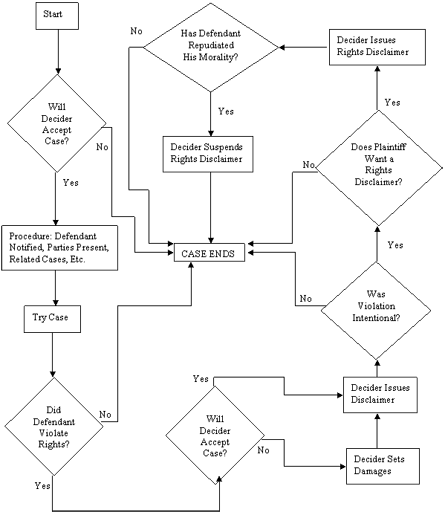
Some things are very noticeable in that diagram. First, the Decider can arbitrarily refuse to accept the case. Second, if the defendant did not violate the plaintiff’s rights, the case ends. No one is liable because he has deep pockets, refused to contract, conspired to violate rights, or enjoyed a vice. If he didn’t violate a right (i.e., changed the property of the plaintiff so as to lower its value to him), he is off the hook. Thus, breaching a contract does not, in itself, violate a right. For example, if two people exchange only promises and not property or services, then one changes his mind, there is no right violation. A very large percentage of U.S. cases never would be heard here because no right violation is even claimed. Second, if guilty, the defendant is given a chance to provide restitution, and he usually takes it and bargains with the plaintiff over the amount rather than let the Decider set the damages. There is no enforceable judgment, only a Disclaimer that states that if the plaintiff recovers specified damages from the defendant, by whatever reasonable means necessary, the Decider (and other Deciders in the their association) will not hear a case by the present defendant against the present plaintiff for that recovery. And finally, if requested, the morality of the defendant vis-a-vis the plaintiff is determined, and the Decider tells the defendant that he will apply the same morality to him. This is a judicial system quite unlike any I have ever heard of before.
There is one more thing about Deciders that I should mention. Kley said that anyone could become a Decider, and, indeed, people did set up Decider businesses all the time. But, I wondered, why would the other Deciders give any respect to a new Decider’s decisions? And, if they didn’t, wouldn’t small wars break out between clients of one Decider who issued a Disclaimer and clients of a different Decider who would not recognize that Disclaimer?
Well, the solution is actually relatively simple. A Decider’s decision has value only to the extent that it can be easily enforced. So, to increase the value of his decisions, a new Decider has a huge incentive to get other Deciders to respect his decision. Of course, other Deciders will respect his decision only if he follows the laws and procedures given by their associations. So he agrees to do this and there is no problem. Judges outside the anarchist society agree to respect the decisions of Deciders in return for the Decider’s agreeing to respect their decisions. But here, Deciders will respect only those Decisions that do not violate rights, and outside judges will respect only those decisions that do not violate the internal laws of their country.
Chapter
50
“Look at it this way,” replied Kley, “if you believe in any form of government, you believe in the use of brute force, not defensively, but offensively. And brute force is not productive. It can only destroy, it cannot create. To build a civilization, to have comforts and luxuries, we must create, not destroy. That’s why anarchy works.”
“The idea that without government nothing will work must be hammered into our heads at an early age.”
“By government-employed school teachers, I suppose,” he laughed.
“Yes,” I replied.
“You know, Teacher said, ‘The impetus for government is the illusion that a society cannot function without a ruler.’”
“Maybe, but anarchy works here only because everyone does the right thing. If enough people started doing the wrong thing, it would collapse.”
“That’s true. The only thing that keeps it going is Principle 3 - people do what they have an incentive to do - and here people have an incentive to do the ‘right thing,’ as you put it. Whenever people support a government, they assume or hope that those in power will do the right thing even though they have every incentive to do the wrong thing. In the end, of course, they follow Principle 3 and do the wrong thing. That’s what happens when you ignore reality, in this case, Principle 3.”
“It’s true that our public officials don’t always act in the public interest,” I conceded.
“Whoa,” said Kley. “It’s a lot worse than that. First, you’ve assumed that there is a public interest. Not true. The members of the public have conflicting interests. And you cannot measure the importance of these interests and cancel them out like so many pluses and minuses to obtain a net public interest. And, of course, if there is no public interest, then there is no justification for government. The closest thing to a ‘public interest’ would be to let everyone pursue their own interests, as long as they respected the rights of others, and that’s anarchy. Second, even if there were a public interest, you’ve assumed that public officials can identify it. Not true. It cannot be identified because there is no valid procedure for identifying it. Third, even if it could be identified, you assume that the officials will, at least most of the time, act in the public interest. Not true. They will act in their own interest. And, it is the interest of members of government to act for the benefit of those who support them. Of course, the people who support them are mostly the people whose income depends upon government force. These are the people who give money for campaigns, parties, or junkets, or who can deliver votes. That includes everyone who gets a government check and everyone who is a member of a government-protected monopoly. Your assumption is based on a lot of premises, all of which are false.
“Remember,” he continued, “for every right violation, someone suffers a loss. Although I deny that benefits and losses to different people can be summed to calculate a ‘net benefit or loss,’ you cannot even claim to act for the ‘net benefit’ of everyone unless you consider those losses. And, if you contend that there is still a ‘net benefit,’ then why violate rights at all? Why not just trade to obtain the net benefit? Then you can be sure there really is one.”
“Because someone will place too high a value on something. For example, he may own a piece of land needed for a road and want an exorbitant price for it.”
“Ah, now you are violating Principle 2.”
“What do you mean?”
“Well, if values are the ends and physical things are the means, then you cannot use a physical thing to determine the importance of a value.”
“I still don’t get it.”
“You are saying that the land is not worth as much as he is asking for it. Why? Because of some objective fact, such as that other nearby land sold for less. But how can the amount of money exchanged for nearby land determine the value of this land? The value of this land is the end - the starting point that determines how much money will be exchanged for it. It is not the other way around, that some physical thing, like money exchanged for other land, determines the importance someone must place on his land. If it did, people would not have free will. Conversely, if you believe we have free will, you cannot say that the value someone places on something is objectively determinable.”
“So the road doesn’t get built?”
“Maybe. But more likely the person is told that unless he lowers the price, the road will be built elsewhere, or even under his land, and he will lower the price.”
“I’ll have to think about that,” I replied. But what I was really thinking about was why these simple arguments were never raised at Harvard. Surely, my esteemed professors must have considered these points and defeated them. Why hadn’t this come up in their lectures?
After a bit of silent walking, I started the conversation again.
“You know, Kley, you told me once that the second biggest propaganda coup was making the government the same thing as the country. What’s the first?”
“Oh, that anarchy is synonymous with social chaos. Of course, anyone who benefits from government is going to promote that view, and they have been extremely successful at it. Whenever two groups of government people fight for the power to steal from a group of producers, they call it anarchy, as though there were no government people present causing the chaos. Every man-made chaotic situation of any magnitude that I’m aware of is caused by government people. Certainly all wars are government wars. Depressions are caused by meddling in the economy by government people, and inflation occurs when they steal our property by printing the money to pay for it. And, as you have seen here, in the absence of government, people organize themselves and the society becomes very orderly, not chaotic. Yet ‘anarchy’ means ‘chaos.’ Do you know of a more successful lie?”
By now I was seriously ambivalent about my mission. No, it was worse than that. I now believed, with all my heart, that, while Teacher was a threat to those in power, indeed, their worst enemy, he was not bad or evil in any sense. He was just a teacher, with strong convictions certainly, and a well thought-out political philosophy, but not a terrorist or anything like that.
And his utopia, well, it certainly isn’t exactly what I or anyone else would want, but, then, no society is. Let’s face it - other people never will behave exactly as we want. The only issue is - are we willing to shoot them if they don’t? Three months ago I might have said “yes.” Rules are for the benefit of everyone and those who won’t follow them must be subjected to whatever force is necessary. Now, I would say that rules are for the benefit of the rule-makers and that no one has the right to forcibly control the lives of others. Coax them, argue with them, cajole them, but, as long as they are not right violators themselves, don’t shoot them. I came here a spy; now, in a moment of re-birth, I became a convert.
Chapter 51
“Oh, yes,” he replied, “everyone is here. How can one be anything else? I look at it this way. Man is a reasoning animal who depends upon his mind for survival. The benefits of man’s mind are lost when man is ruled by force. Therefore, the use of force is in opposition to man’s nature. Since government is the institutionalization of force, we should oppose all forms of government.”
“That’s an interesting argument,” I replied, “but is sounds like an is-ought argument.”
“Oh, what’s that?”
“Well, it sounds like you’re saying that because man has a certain nature, we ought to oppose government.”
“Yes, I am, but so what?”
“Well, David Hume showed, I think convincingly, that you can’t get an ‘ought’ from an ’is.’ That is, you can’t start with a statement that contains no ‘ought’ and reason to a statement that does contain an ‘ought.’ You can’t pull a bunny out of a hat unless the bunny is in the hat. Your statement about the nature of man, while true, contains no ‘ought,’ so you can conclude nothing about what people ought to do.”
“Oh,” he said, looking disappointed.
I paused. “But you can start with an ought or should statement that most people will accept and reason to another ought or should statement. Let me give you some examples. Let’s start with the statement that people should not live parasitically off other people. ‘Living parasitically’ means achieving values at the expense of the values of others, that is, using the property of others to achieve values in a way that prevents the owners of that property from achieving their values, in other words, violating the rights of the owner. Since government is an organization of people who openly violate rights, that behavior is parasitic, and people should not live parasitically, we can conclude that government should be abolished.
“One could also argue that one should not steal. Since government people cannot, by any argument of which I am aware, claim they own the property they seize, or are authorized by its owner to seize his property, they are thieves and ought to stop being thieves.
“Finally, one could start with the statement that one should not kill. If government people did not kill, government could not exist. Suppose they give me an order and I say ‘no.’ They then use force against me, and I defend myself with force. As we both escalate the amount of force, they eventually must either kill me or see their government disappear. Since they should not kill me, their government should disappear.”
At this point, I noticed that the room was silent - I was the only one talking. I looked around, and all the older people were listening to me! Then Kley, with an expression of amazement and admiration on his face, started clapping, and everyone in the room started clapping. I’m sure my face turned a bright red color. I excused myself to go to the bathroom. Once there, I made a fist and shouted “yes!” under my breath. After an entire summer of losing arguments, of always being wrong, at last I had won one. I was an equal! I could hold my own with the best of them. My confidence took a giant leap. This was the greatest triumph of my life!
When I came back, they were all talking again, oblivious to my elation. The rest of the evening I said almost nothing. There was no way I was going to risk saying something stupid and ruin this perfect evening.
Chapter 52
“My God,” I thought, “It’s Kley!” I was about to call out to him, but something told me it might not be a good idea. I let him pass without a word, then slowly walked back, making sure not to catch up to him.
The next day I was having lunch with Sharlee at Our Spot.
“Did you hear the news?” she asked.
“What’s that?”
“There was a letter from Teacher this morning. It was about the house in the park.”
“What did it say?”
“It said that the present occupants are not innocent because they acquired the house with the help of the Commissar, and the Tsar’s agent’s heirs are not innocent either because their claim of title comes from the Tsar’s agent. It said the victims of the Commissar and the Tsar’s agent should be allowed to claim the house.”
I don’t know if that was a good resolution of the problem or not because I wasn’t thinking about that - I was thinking about Teacher and how I could find out who he was. At this point I was not so much interested in helping the U.S. government as I was in collecting material for a story, perhaps even a book.
“Sharlee, who got the letter from Teacher?”
“Why, no one. It was taped to the memorial in the square.”
I nearly fell over. Kley! He taped it there last night. He had to be Teacher.
“Sharlee, it’s Kley! He’s got to be Teacher.” I told her what happened last night and she agreed that either Kley was Teacher or at least he knew who Teacher was. We spent the rest of our lunch time reviewing all the clues that pointed to Kley being Teacher - his vast knowledge of Teacher’s philosophy, even of fine points that one could not find written down in The Book. It had to be Kley. He was politically active, resourceful, worldly, and knew almost everything about the society through his business.
Then, abruptly, she announced, “Matt,” she said, “I have to go. I’ll see you later.”
“OK. That’s fine,” I replied, though I was puzzled by her sudden departure. I needed time to think, anyway. When she left, I turned to my next problem - should I let Regina know? I felt some obligation to do so since that is why I was sent here. But if I did, I might be endangering Kley, in addition to betraying his trust in me. On the other hand, it might open up negotiations that would reduce the hostility of governments to this anarchial society. I thought about this for a while. Then I decided that no good would come from identifying Teacher. After all, no negotiations were possible since Kley represented no one and had nothing to negotiate. Moreover, he never would concede that his philosophy was wrong or should be compromised. I remember him quoting Teacher once, “To compromise one’s principles is to admit they are in error.” Besides, I remember how someone here had told me how the West spent hundreds of billions of dollars on armaments to fight Communism, yet it was ultimately destroyed by nothing more than fresh air. Once it was exposed as a false idea, it no longer had the power to move men. That is why Teacher is so dangerous to government people - if Teacher’s ideas are ever considered and accepted, it will be the end of their power. With those thoughts, I began to regret even blurting out to Sharlee that Kley was Teacher. I went back to Kley’s house and worked on my notes.
That night, after dinner, there was a knock at the door and Kley went to answer it. Suddenly, there was a loud report from a gunshot and Kley fell backwards onto the floor. Yom grabbed a gun from under the couch and fired back, but the man disappeared into the night.
We bent over Kley. He had only a few breaths left.
“Kley, I’m sorry. I told Sharlee you were Teacher. She must have told your enemies.”
He raised his hand and touched my lips. “Will you follow Teacher?” he asked.
“Yes,” I said.
“Then I will live through you.” He smiled, looked at Yom, closed his eyes, and died.
Tears were pouring down Yom’s face - the only emotion I had ever seen her display. We were both crying.
People began to arrive - neighbors, then insurance detectives, and finally the morticians. Later, after they had all left, Yom said to me, “I not want you here. I fear this happen. Kley knew elites plotting. They destroy us. You help us.”
I assured her that I would help.
The murderer, a Mongolian from China, was found shot to death in an alley in the Colony, his reward for trusting Kley’s enemies.
Later, Sharlee came to talk to Yom. I was already torn between my love for her and my strong suspicion that she had told Kley’s enemies that he was Teacher. After all, didn’t she become quiet and leave suddenly when I told her yesterday? Wasn’t the killer from China? But then she hit me with a bigger shock.
“Yom, Matt, I have to tell you that I am a spy. I work for the Chinese government.”
“What! You told them, didn’t you?” I yelled. “You told them Kley was Teacher.” She denied telling anyone that Kley was Teacher. Anyone else I would not have believed, but I was too much in love with her to think she was lying. Besides, why would she admit she was a spy and add suspicion to herself unless she was really innocent? She explained that she had agreed to spy for the Chinese after they arrested her brother at the Tiananmen Square massacre. Only by spying could she save his life. The Chinese, like the Americans, also wanted to identify Teacher. She had fed them the same sort of information that I was feeding Regina, but she did not give them anything that would be really useful to them. Now that Teacher was dead, they agreed to free her brother and permit him to emigrate.
After that I felt like a terrible hypocrite, since I had been a spy too. I confessed that I, too, had been sent here as a spy, and apologized to Sharlee.
Surely Kley was killed because somebody thought he was Teacher, and I was the only one who knew for certain that he was Teacher. How could they have found out? Sharlee, Yom, and I thought about this then realized that the only time either of us said out loud that Kley was Teacher was when Sharlee and I met at Our Spot for lunch. Of course, that had to be it! We always met there, so someone had bugged it. Carefully, Yom, Sharlee, and I made our plan to catch the bugger.
Chapter 53
We drove away from town, out onto a desolate spot on the steppes. There, mats were spread and we sat on the sparse grassland, facing a funeral pyre. Soon, there were hundreds of people around us, many armed with machine guns and heavy weapons. Obviously, they thought an attack might be imminent and were prepared to fight. I began to worry about planes attacking, since there was no where to hide.
Beautifully sad pounding music filled the air and, remembering what Kley had said about God, I knew it had to be Beethoven’s. The muscular Extractor I had seen before with Kley, dressed in his full warrior regalia, and the president, Tserenpiliin Jigjig, similarly dressed, carried a stretcher with Kley’s body on it and placed it on the pyre. I imagined they looked like the guards of Genghis Khan must have looked, hundreds of years ago. Kley was also dressed as a warrior, with a dagger strapped to his arm. They lit torches on each side of the pyre and stood beside it.
When the music ended, Yom walked to the front of the pyre and began speaking. She spoke in Mongolian, but Sharlee whispered to me an English translation of what she was saying.
“I was only 10 when my mother married Kley’s father and my mother and I moved in with them. Though we were very different, Kley and I became friends immediately. Kley was an American - outgoing, uninhibited, and suspicious of authority. I was a shy, serious student, and a devout member of the Young Communists. We argued constantly. Every time I repeated some Communist doctrine, Kley would laugh and explain that it wasn’t like that in America.”
Kley defending America, I thought. That’s a switch, but, of course, he was defending the country, not the government.
“I was losing every argument. It seemed like everything I believed was wrong. I felt very foolish for having accepted without question what I had been taught, and I determined that never again would I let that happen to me.”
It sounded like a repetition of my experience with Kley.
“As the years passed, my admiration for Kley grew into love. I have had many, many teachers, but no one taught me as much as Kley. ‘Go that way,’ Kley told me, and he pointed to a sign that said ‘Truth,’ and I went.”
Again, I thought, that’s what he did to me. I wondered how many others Kley had influenced in this way. “I have never once regretted my life with Kley. Were it not for Kley, I would be a tangle of contradictions, frantically trying to keep my conflicts from my awareness, blind to reality. Instead, all the pieces of my mind fit together, as clear as an icicle.
“But Kley did more for me than that. He also gave meaning to my life. Here was a man without religion, who knew exactly why he was here and what the purpose of his life was. ‘Grow,’ said Kley, ‘become all that you are capable of becoming.’ We are seeds, he taught me, and our purpose is to grow - to develop our talents, our abilities, our knowledge - to become the best that we can become.”
This was new to me, because Kley and I had never discussed the meaning of life.
“There are two titanic forces that shape our lives - the creative force and the destructive force. They are contradictory and cannot peacefully coexist, so they struggle without respite. By our actions, we create these forces and give them life. Kley was a fountainhead for the creative force and it sprang from him as naturally as honey bees from a hive. He taught the blessings of respect for human rights. As a result, those who profit from violating rights targeted this gentle, learned man. He lost his life to the eternal struggle between creation and destruction, but, it was a price he was always prepared to pay. Though he is no longer here to teach us and guide us, his voice has not been silenced, for he speaks through me, through you, and through many hundreds of others. Kley lives on, the only way any of us can - through the ideas he lived by. Kley’s struggle was my struggle. And as long as man yearns for his freedom, it will be man’s struggle.”
Then Ziggy and Kley’s saturday night friends and other people came up to the pyre and said a few words, each telling how Kley had changed his life. When they finished, the muscular Extractor walked behind the pyre, drew his dagger, cut his left forearm, and let his blood drip onto Kley’s body. Many others did the same. Last came Yom. She held out her hand to the Extractor and he placed his dagger in it. She cut her forearm and her blood dripped onto Kley.
The two pallbearers took the torches and lit the pyre. Then the music began again, but this time it was joyous, triumphant music, so grand, I wondered if Kley had really been joking about Beethoven being God. I just stared, transfixed by this scene from another age.
The flames burned intensely and soon all that was left were ashes. Yom walked through the ashes followed by those who had spoken and everyone began to leave.
Sharlee told me that the blood letting symbolized that a part of them died with Kley, and they walked through the ashes to take part of Kley back to their homes with them. I felt really low after that. I should have been up there speaking, for surely Kley changed my life as much as anyone’s. But I had no right to because it was my big mouth that had lead to his death.
That evening I told Yom I was going for a walk. I walked into town and took a cab back to the steppes where the funeral had taken place a few hours earlier. The moon cast an eerie paleness to the desolate prairie. I walked over to the ashes and stood there, remembering the scene from earlier in the day. Then, glistening from the ashes, I saw Kley’s dagger. I picked it up. Only the metal was left. I don’t know what was happening to me then, but I was overcome by powerful emotions. I shoved up my left sleeve, cut my forearm, and let the blood drip onto the ashes. It just seemed like the right thing to do. I stuffed the piece of metal inside my shirt, dragged my feet through the ashes, and walked back to the cab.
When I arrived back at the cottage, Yom was sitting there, reading. “Drink?” she asked. I nodded, and she went into the kitchen. I nervously straightened my shirt so the metal would not be noticeable.
She came out of the kitchen carrying a glass of ice tea. Suddenly her face looked shocked and the glass went crashing across the stone floor. My feet, she was staring at my feet! I had forgotten about walking through the ashes and my shoes were still covered with them.
She said nothing, but walked straight to me. I wasn’t sure what she would do. Perhaps I had violated some cultural taboo or something. She grabbed my left arm, pushed the sleeve up and stared at my fresh wound. She touched the metal under my shirt and looked straight at me, her piercing eyes trying to understand the meaning of this. Then she turned and walked away into her bedroom. I cleaned up the glass.
The next day I told Sharlee what I had done and asked her if it was wrong for me to take the piece of metal. No, she said, the legend is that the dagger belongs to the new warrior who will replace the one who has fallen. A sudden rush of pride went through me at the thought that I was somehow replacing Kley.
We went to a small shop in the Colony. Soon, the metal piece was clean and shiny again and fitted with new bindings. I wondered how many warriors had retrieved it from the ashes before me, and who would retrieve it from my ashes.
Chapter 54
“God, I wish we could catch the bastards who were behind this,” I said.
“You know, Matt, Kley kept a list of people who he either knew were spies or thought might be spies. It included their contacts - who they worked for. We could see if the killer was on the list and find out who he worked for.”
“Hey, that’s a good start. The insurance company detectives would love to check out those leads. Where’s the list?”
“It’s in my apartment, under my mattress. Why don’t you come over for dinner tonight and we can go over it.”
I went back to Kley’s house and waited with Yom. The phone rang. She nodded at me. We waited some more. The phone rang again. “Regina,” she said.
Many emotions hit me at once. Anger, that U.S. government people had killed Kley, who was after all, a U.S. citizen. Anger that they had lied to me and used me to obtain his identity. Shame that my government would do this. Embarrassment at being in Yom’s house when it was my stupidity that gave them Kley’s identity. I should have known.
Chapter 55
“When I get back I’ll tell the truth about this society and Kley,” I said. “Since Kley was Teacher, I would like to name him as Teacher, if it’s all right with you.”
She wiped her tears, then turned to me. “Yes,” she said, nodding her head, “Kley teacher.” She paused and wiped her eyes again. “But,” she continued, shaking her head, “Kley not Teacher.”
My jaw dropped, for I was utterly stunned. What was she saying? That Kley had been killed by mistake? How could I have been wrong about this?
When she saw my amazement, she slowly smiled, the first time I had ever seen her smile, and then I knew who Teacher was. “The letters,” I thought, “they came from her.” Kley only posted them. She was the originator of the ideas; Kley was the disseminator.
She knew I knew, but had trusted me with this vital information, surely a compliment of great magnitude.
Sharlee now had no more reason to be only a friend and was relieved that she could show her love to me openly. We decided to return to the U.S. together, but I had one more chore to do before I met her and Yom at the airport. I could have let Yom take care of things with Regina, but I had to confront Regina, so I went to her apartment.
“Who’s there?” she demanded. I identified myself. She looked me over carefully though the peek hole, then let me in.
“Oh, hi, Matt, how are you today?” she said cheerfully.
“I know you killed Teacher, you bastard.”
“What are you talking about?”
“Enough pretense. We know you bugged Our Spot in the park. We know your agent searched Sharlee’s apartment and gave you Kley’s list. You’re dead! You know that? You’re dead!”
She said nothing for a while, then recovered herself. “You know, you idealists are really dumb,” she said, contempt dripping from her voice. “You think philosophy makes a difference. Well, it doesn’t. The only thing that makes a difference is who has the most guns.”
“Yeah, well those guns are useless unless people are willing to shoot them. And which way they shoot depends on what they think. And what they think depends on their philosophy.”
“They don’t think, Matt. They only obey. The leaders tell them what to think.”
“You mean the leaders try to tell people what to think. Whether they will succeed or not is the issue. It is a battle of ideas. That’s why you killed Teacher. It wasn’t because he had a gun, it was because he had an idea, an idea that threatened your power. That’s why The Book isn’t translated or published, isn’t it?”
There was silence for a moment.
“You know, Regina, I was wrong about you. I thought you didn’t have a clear philosophy - that your ideas were just a muddle. But you do have a philosophy. It goes something like this: There is no soul, no after life, no morality, no rights. The only value in life is increasing your own pleasure and reducing your own pain. To that end, the lives and happiness of others can be sacrificed.”
She fidgeted with a cigarette, but did not respond.
“The flaw in that philosophy, maybe not the only flaw, is that the philosophy itself will reduce your pleasure and increase your pain.”
“You’re only half right, Matt. It’s all about power and the pleasure it brings. Power is the ultimate drug. Once you’ve tasted it, you crave it more than anything else in life. I use my mind, my body, every skill I have, just for the high I get from power. I shaped history here, Matt. Think of it. All of history, forever, was changed because of me.”
Then she leaned toward me and whispered her secret, “The power to change history is the power of a god!”
With those words I remembered Ziggy talking about how we aspire to be gods when we despise our real self, and, for just an instant, I felt sorry for her. Then my anger returned.
“Yeah, well let me tell you something, babe. This is the end of your power. If the Extractors don’t chop you up, I will. When I get back to the States I’m publishing The Book and Teacher’s Political Guide and I’m telling the whole story about what happened here. This is your last high, toots.”
As I started to leave, she called out, “Matt, do you think I’m acting on my own here? You’re taking on the most powerful organization on the face of this earth. You can’t even guess at what it can do.”
That startled me, as I expected her to be on the defensive, not me. But I retained my composure, slammed the door, and left.
Because my meeting with Regina took longer than I expected, I was late getting to the airport. When I told Yom and Sharlee about my last encounter with Regina, Yom said, “Regina dangerous.” Yom told me that a few hours earlier John Templeton showed up at Kley’s cottage with two other men. They struck a deal with her: Regina in return for a large amount of money. Silence about U.S. complicity in Kley’s death in return for an end the propaganda war and full recognition of the new “government” of Mongolia. If the U.S. government people broke their side of the bargain, the evidence, including incriminating videotapes, would be released to the world press. I thought it might work, at least until it became old news and no longer a threat to the U.S. power elite. But I had not agreed to keep silent and I fully intended to tell my story. Besides, part of my deal with the State Department bureaucrats was that I got to break any story.
There was one more fond farewell to Yom, then Sharlee and I left. There would be much work to do when I returned home with my incredible story.
THE END
Postscript
While Matt’s parents do not want to deny their son his incredible story, nevertheless they believe that, if Matt and Xiaoli are being held in China, the publication of his notes may be the best way to secure their release. Since Kley thought, erroneously, that I had copied Teacher’s book, they believe that I am the best person to edit Matt’s tapes and notes and publish them as this book.
Matt recorded many of his thoughts and conversations on tapes he mailed to his parents, and I have reproduced them verbatim. While I have tried to remain faithful to his written notes, I have also relied on Yom and Matt’s parents for additional material.
Richard D. Fuerle
Copyright © 1992 Spooner Press.
Published with permission from the author and publisher.